
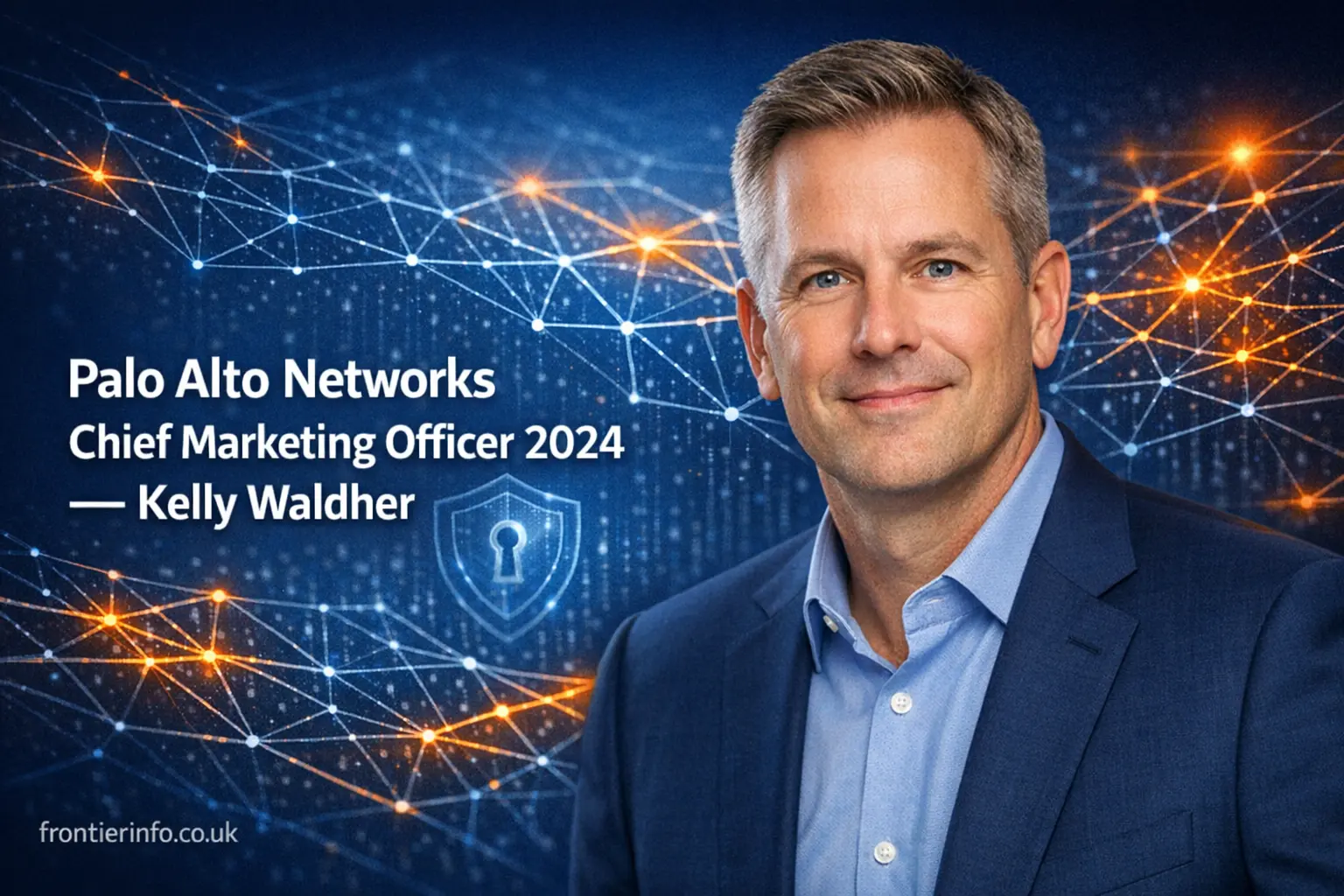
The people who search for the Palo Alto Networks chief marketing officer 2024 position need more than just the name of the candidate. The people want to know who the person is and what they accomplished and what their work involves and how their work impacts one of the most significant cybersecurity businesses in the world. The article provides all the necessary information which is presented in a straightforward manner.
The answer to the core question is Kelly Waldher. He currently serves as Executive Vice President and Chief Marketing Officer at Palo Alto Networks, and his role goes farther than standard marketing executive duties. He leads the company’s efforts to establish itself as the top global expert in AI-enabled cybersecurity solutions which affects all customer interactions and product introductions and international brand choices.
Who Is Kelly Waldher?
Kelly Waldher didn’t arrive at Palo Alto Networks through a conventional path. He’s a career enterprise tech executive whose background spans four of the most influential software companies of the past two decades — and each chapter of his career built something specific that this role demands.
He is described officially as a tenured marketing executive with a diverse background spanning top tech companies. His mandate at Palo Alto Networks is to lead the transformation and scale of the company’s go-to-market initiatives, with the goal of making Palo Alto Networks the go-to platform for cutting-edge, AI-powered security solutions. That’s not a vague aspiration — it’s a structured commercial objective that his entire organization is built around achieving.
Waldher is based in Seattle, Washington, and leads a global marketing function that operates across more than 150 countries. The scale of that responsibility is significant. Palo Alto Networks has tens of thousands of customers spanning every industry vertical, and each of those relationships requires consistent, credible, technically accurate communication.
Kelly Waldher’s Career Before Palo Alto Networks
Understanding where Waldher came from explains a lot about how he leads today. His professional history covers enterprise productivity software, customer experience platforms, cloud collaboration tools, and customer service technology — a sequence that, looking back, reads almost like a deliberate preparation for running marketing at a cybersecurity giant.
He spent 14 years at Microsoft, serving as General Manager for the Microsoft 365 commercial and consumer portfolio. That’s an unusually long tenure for a senior executive in the modern tech industry, and it reflects a depth of institutional knowledge that short-term roles simply cannot produce. During those years, he developed an understanding of how to market a platform — not just a product — to enterprise buyers making complex, multi-year purchasing decisions.
After Microsoft, he joined Qualtrics as Executive Vice President and General Manager, taking ownership of specific business units including BrandXM and DesignXM. Qualtrics operates in the experience management space, a category that is fundamentally about helping companies understand how they are perceived by customers, employees, and partners. This role gave Waldher something that pure product marketers rarely develop: a deep understanding of brand trust as a measurable business outcome.
From Qualtrics, he moved to Google, where he served as Vice President of Marketing for Google Workspace. In this role, he oversaw global marketing functions across consumer, small business, and enterprise segments simultaneously. His responsibilities included brand management, product marketing, demand generation, growth strategies, and analyst relations — essentially the full breadth of a modern enterprise marketing organization. He spent over three years at Google, during a period when Workspace was establishing itself as a serious Microsoft 365 competitor.
His most recent stop before Palo Alto Networks was Zendesk, where he held the title of Chief Marketing Officer. At Zendesk, he led marketing, communications, and sales development teams, and simultaneously served as General Manager of the online business segment. This dual responsibility — running marketing while also owning a business unit — required the kind of commercial accountability that pure brand leaders rarely carry. It also coincided with Zendesk’s significant investment in AI-powered customer service capabilities, which gave Waldher direct experience navigating a technology inflection point from a marketing leadership seat.
His academic credentials complete the picture. He holds an MBA from Harvard Business School and a Bachelor of Science in Chemical Engineering from Washington State University. The engineering degree is worth noting specifically. Marketing executives in cybersecurity who have genuine technical foundations communicate differently than those who don’t. They ask better questions, they catch oversimplifications before they reach the market, and they earn credibility with the technically sophisticated buyers they’re trying to reach.
Why His Background Is Exactly Right for This Role
There’s a version of this article that simply lists Waldher’s previous employers and moves on. But the more interesting question is why each of those roles prepared him specifically for the challenges of marketing at a company like Palo Alto Networks.
The Microsoft chapter gave him platform marketing experience at massive scale. Palo Alto Networks’ entire commercial strategy in 2024 is built around what CEO Nikesh Arora calls “platformization” — the idea that customers should consolidate their security spending onto integrated Palo Alto Networks platforms rather than managing a collection of point solutions from different vendors. Selling that concept requires a CMO who understands how platform narratives are built, sustained, and defended over multi-year selling cycles. Waldher spent 14 years doing exactly that.
The Qualtrics chapter gave him something less obvious but equally important: a sophisticated understanding of trust as a product. Experience management as a discipline is fundamentally about measuring and improving the gap between what a company promises and what it delivers. That gap — between claim and reality — is where cybersecurity brand trust is made or destroyed. A CMO who has spent years thinking carefully about that gap is better equipped to protect it.
The Google chapter gave him experience operating at global scale across multiple market segments simultaneously. Cybersecurity marketing at Palo Alto Networks’ level isn’t a single audience or a single message. It’s a complex matrix of enterprise buyers, mid-market buyers, government customers, channel partners, security researchers, industry analysts, and the financial community — all requiring different approaches while maintaining a coherent brand identity.
The Zendesk chapter gave him his first formal CMO seat, where he learned to own the accountability that comes with the title. More importantly, it gave him direct experience leading marketing through a period of AI-driven product transformation — which is precisely the environment he walked into at Palo Alto Networks.
The “Deploy Bravely” Philosophy That Defines His Leadership
Marketing philosophies are often generic enough to apply to almost any company. Waldher’s is specific enough to only really work at Palo Alto Networks, which is what makes it interesting.
He has written publicly about his core belief: that true innovation is about building capabilities that earn and maintain the trust of customers, partners, and employees. His view is that innovation must be secure by design — not secured afterward, not secured as an afterthought, but built with security as the structural foundation. This, in his framing, is what makes sustainable growth possible. You can’t scale what you can’t trust.
He calls this philosophy “Deploying Bravely.” The phrase captures something genuine about how he thinks the relationship between security and innovation should work. In most technology conversations, security is presented as a constraint — something that slows things down, requires extra steps, and limits what’s possible. Waldher inverts that framing entirely. His argument is that when security is genuinely built in from the beginning, you can move faster, not slower. You can take bigger creative risks. You can deploy bravely.
This philosophy produced a marketing campaign called “Be a Genius” — and the execution of that campaign was itself an expression of the philosophy it was promoting. The campaign was built using the same AI-powered technology infrastructure that Palo Alto Networks is in the business of protecting. The message wasn’t just communicated — it was demonstrated. That’s the kind of campaign concept that only emerges when the CMO understands the product deeply enough to find the connection between what the company does and how the marketing team actually works.
Waldher has also written about the relationship between brand trust and innovation speed in the current AI environment. His argument, articulated in his own published writing, is that in an era where AI is accelerating everything, the companies that win will be those who build trust fast enough to justify the speed at which they’re moving. Security isn’t what holds you back. It’s what gives you permission to go further.
What the CMO Actually Oversees at Palo Alto Networks
The scope of a CMO role at a company of Palo Alto Networks’ size is far broader than most outside observers appreciate. This is not a role focused on brand advertising or social media presence. It’s an organizational leadership position that coordinates multiple specialized disciplines toward a single commercial objective.
Waldher’s organization covers demand generation, which means designing and executing the campaigns, content, and digital programs that create qualified interest among prospective enterprise buyers. It covers product marketing, which means translating the technical specifications of products like XSIAM, Prisma AIRS, and next-generation firewalls into messages that resonate with C-suite buyers who are evaluating risk and return, not feature checklists. It covers brand management, which means maintaining a consistent identity and reputation across every customer touchpoint globally.
It covers communications, which means managing how the company responds in real time to threat disclosures, industry news, competitive developments, and security incidents. It covers analyst relations, which means building and sustaining relationships with Gartner, Forrester, IDC, and other research organizations whose published assessments directly influence enterprise purchasing decisions. And it covers events, including the annual Ignite conference, which functions simultaneously as a customer loyalty platform, a partner engagement vehicle, and a demand generation engine.
Waldher himself serves as the opening welcome voice at major company events. He appeared as the first speaker in Chapter 1 of Palo Alto Networks’ flagship TV event series, welcoming attendees before the CEO keynote — a positioning that reflects how central marketing leadership is to the company’s public-facing identity.
Palo Alto Networks’ Marketing Strategy in 2024 and Its Results
The commercial context for Waldher’s 2024 mandate is important. CEO Nikesh Arora made a decisive and somewhat controversial strategic pivot in early 2024: Palo Alto Networks would double down on platformization as its primary growth driver, even at the cost of short-term revenue growth. The idea was that customers who consolidated onto full Palo Alto Networks platforms would spend more over time, churn less, and become deeper strategic partners rather than transactional customers.
That pivot created an immediate and specific marketing challenge. Platformization is a technically complex concept that requires buyers to rethink procurement decisions they may have already made, change internal workflows, and trust a single vendor with security functions they had previously distributed across multiple point solutions. Convincing skeptical, technically sophisticated enterprise security buyers to make that shift is not a simple marketing problem. It requires sustained thought leadership, precise product marketing, and a brand narrative strong enough to carry the weight of an enterprise-wide transformation decision.
The strategy appears to be working. Palo Alto Networks concluded fiscal year 2024 with total revenue of $7.95 billion. In Q1 of fiscal year 2025, the company added over 70 new platformizations, bringing the total to approximately 1,100 platformized customers, with average revenue per platformized customer increasing by 6% compared to the fiscal year 2024 average. The Cortex platform crossed the $1 billion ARR milestone in Q1 of fiscal 2025. These numbers reflect a marketing function that is successfully translating a complex strategic narrative into actual commercial outcomes.
Why Cybersecurity Marketing Is Harder Than It Looks
This is the part that most articles on this topic skip entirely, but it’s essential for understanding what makes Waldher’s role genuinely difficult.
Cybersecurity buyers are among the most sophisticated enterprise purchasing decision-makers in any technology sector. A Chief Information Security Officer who has spent 20 years in the field has seen hundreds of vendor pitches, read thousands of marketing claims, and lived through multiple cycles of hype that didn’t match reality. They have finely tuned sensitivity to vague promises, overclaiming, and technical inaccuracy. Any marketing message that can’t survive contact with a technically skeptical CISO will not survive contact with the actual buying process.
The stakes involved in cybersecurity purchasing decisions are also categorically different from most enterprise software categories. A poor choice of HR software or project management tool creates inconvenience. A poor choice of security platform can expose customer data, trigger regulatory consequences, disrupt operations, and destroy the trust that companies spend decades building. Buyers know this. The emotional and professional stakes shape how they process marketing information, what they trust, and how long they take to make decisions.
The threat landscape that defines the product category changes constantly. A campaign built around a specific threat vector or compliance requirement can feel outdated within months if the environment shifts. The marketing team has to be agile enough to update its narratives quickly without losing the brand consistency that enterprise buyers rely on when making long-term vendor commitments.
And the sales cycle itself is far longer and more complex than in most technology markets. Enterprise security decisions involve CISOs, CTOs, CFOs, legal and compliance teams, board-level risk committees, and procurement organizations — often simultaneously. Marketing content has to serve every stage of that extended evaluation process, for every stakeholder type, across every geography where Palo Alto Networks operates.
Navigating all of that requires exactly the combination of technical credibility, enterprise marketing experience, and commercial accountability that Waldher’s career has systematically developed.
FAQ
Who is the Palo Alto Networks chief marketing officer in 2024?
Kelly Waldher is the Executive Vice President and Chief Marketing Officer at Palo Alto Networks. He is responsible for the transformation and scale of the company’s go-to-market initiatives, with the mission of establishing Palo Alto Networks as the foremost authority in AI and cybersecurity globally.
When did Kelly Waldher become CMO of Palo Alto Networks?
Waldher joined Palo Alto Networks as CMO following his tenure at Zendesk, where he had previously held the same title. His arrival aligned closely with the company’s 2024 strategic pivot toward full platformization as its primary commercial growth driver.
What companies did Kelly Waldher work at before Palo Alto Networks?
He spent 14 years at Microsoft as General Manager for the Microsoft 365 portfolio, then served as EVP and General Manager at Qualtrics, followed by VP of Marketing for Google Workspace at Google, and most recently as Chief Marketing Officer at Zendesk before joining Palo Alto Networks.
What is Kelly Waldher’s educational background?
He earned an MBA from Harvard Business School and a Bachelor of Science in Chemical Engineering from Washington State University. His engineering degree gives him a technical foundation that is relatively rare among senior marketing executives in the cybersecurity industry.
What does “Deploy Bravely” mean in the context of Palo Alto Networks?
It is Kelly Waldher’s core marketing philosophy, which holds that true innovation requires security to be built in by design — not added afterward. When security is the foundation, companies can innovate faster and take bigger risks because the foundation itself is trustworthy. The philosophy drives both the company’s brand messaging and its campaign execution strategy.
How does the CMO role connect to Palo Alto Networks’ financial results?
The marketing function is directly tied to the company’s platformization strategy, which is its primary growth engine. By building the brand authority, thought leadership, and demand generation programs that encourage customers to consolidate onto Palo Alto Networks platforms, the CMO’s organization helps drive the increase in revenue per customer that platformization is designed to produce. Fiscal year 2024 revenue reached $7.95 billion, with strong growth in Next-Generation Security offerings.
What makes cybersecurity marketing uniquely challenging?
Cybersecurity buyers are technically sophisticated and professionally skeptical. The purchasing stakes are high — poor decisions have real consequences for companies and careers. The threat landscape changes rapidly, requiring marketing agility. And the sales cycle involves multiple senior stakeholders across long timeframes, requiring marketing content that serves different audiences at different stages simultaneously. These factors make cybersecurity marketing structurally more demanding than most enterprise software categories.
Conclusion
The Palo Alto Networks chief marketing officer 2024 is Kelly Waldher, and now you have a complete picture of why that matters. He came to the role carrying more than two decades of enterprise marketing experience across Microsoft, Qualtrics, Google, and Zendesk. His “Deploy Bravely” philosophy puts security-by-design at the center of every creative and strategic decision his team makes. His technical education gives him credibility with buyers that most marketing executives can’t access. And his experience leading marketing through AI-driven product transitions at Zendesk prepared him directly for the environment he walked into at Palo Alto Networks in 2024.
For anyone studying executive leadership in cybersecurity, B2B marketing strategy at enterprise scale, or how major technology brands navigate platform transition narratives, Waldher’s approach offers a genuinely instructive model. The results — more than 1,100 platformized customers, $7.95 billion in fiscal 2024 revenue, and accelerating Next-Generation Security ARR — suggest the marketing engine he is running is doing exactly what it was designed to do.
