
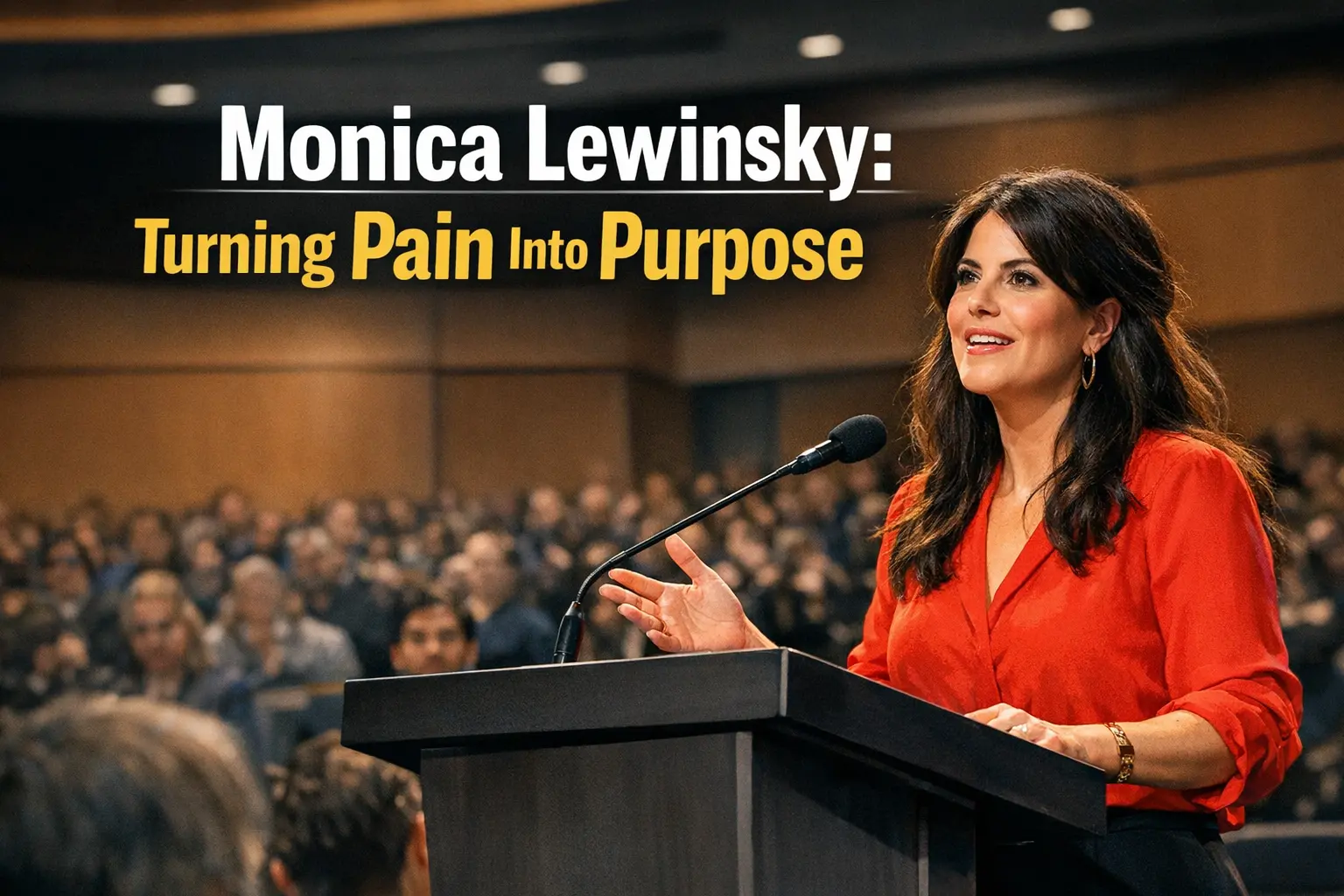
The name should be familiar to you. However, the complete narrative remains unknown to you because you do not know what happened after the scandal.
Monica Lewinsky became the most publicly humiliated person on Earth when she turned 22. The world treated her in 1998 and it took three decades for the world to recognize what it did. Her experience brought her through life challenges which she used to create a powerful story about her life. Today, Monica Lewinsky works as a global anti-bullying activist while she produces Emmy-nominated campaigns and delivers TED Talks which have reached approximately 22 million viewers and she is recognized as one of the most powerful voices that discuss the internet’s most cruel impact.
This is her true story.
Who Is Monica Lewinsky, Really?
Most people create their mental picture of Monica Lewinsky through tabloid articles and late-night comedy shows. The actuality presents a more complex situation.
In 1995, at 22 years old, Lewinsky began working as a White House intern in the Office of Legislative Affairs. She became romantically involved with President Bill Clinton — a relationship that, when it became public in 1998, triggered one of the most explosive political and media storms in American history. Clinton denied the affair on national television while Lewinsky faced potential federal charges that would lead to 27 years in prison. The press coverage of her life began to destroy her reputation.
The timing of her case created special circumstances which made it particularly painful. The internet existed at that time as an unregulated platform which contained its initial development stage. The system operated without any established guidelines which prevented users from accessing all parts of it. Private conversations were leaked. Her appearance was mocked. They destroyed her public persona through online attacks which occurred during a worldwide broadcast. She was 24 years old. There was no name yet for what was happening to her — what we now call cyberbullying, slut-shaming, and online harassment.
She later described going to bed one night as a private person and waking up the next day known around the entire world. For the worst possible reasons.
A Decade of Silence — and What Broke It
After the scandal, Lewinsky largely disappeared from public life. She moved abroad, earned a master’s degree in social psychology from the London School of Economics, and spent roughly a decade trying to quietly rebuild a life. Job offers evaporated. Her name was radioactive. She’s spoken openly about how dark those years were.
The turning point came in 2010. The suicide of 18-year-old Tyler Clementi — a Rutgers student secretly filmed being intimate with another man and then publicly shamed on social media — hit her in a deeply personal way. She recognized something of herself in that story. And she noticed something else: there were almost no public figures who had survived a massive public shaming and come out the other side willing to talk about it.
In 2014, she broke her silence with a landmark essay in Vanity Fair. It was the first time she had told her own story, in her own words, publicly. The response was overwhelming. Something had shifted — younger generations, who had grown up online, were beginning to see the events of 1998 very differently than the media had framed them at the time.
Monica Lewinsky’s Anti-Bullying Campaigns: What She’s Built
Since returning to public life, Lewinsky hasn’t just spoken about bullying — she’s built a sustained body of work around it. Here’s what that looks like:
“In Real Life” (2017) — Her first major PSA campaign, which visualized how common online behavior would look if it happened face-to-face. The campaign was nominated for an Emmy Award.
“#DefyTheName” (2018) — A social media campaign where Lewinsky publicly changed her display name to include the worst things she’d been called over the years — including “Monica Chunky Slut Stalker That Woman Lewinsky.” She challenged others to do the same, turning names used to demean into acts of defiance. Celebrities including Lena Dunham and Sarah Silverman joined in. The core message: don’t let the names others call you define you.
“The Epidemic” (2019) — A PSA produced with ad agency BBDO New York depicting a teenage girl who develops a “mysterious illness.” The illness, of course, is the real-world toll of online harassment. The campaign supported 11 of the world’s leading anti-bullying organizations.
“Stand Up to Yourself” (2023) — Perhaps her most personal campaign yet. Lewinsky turned the lens inward, confronting the often-overlooked issue of self-bullying — the cruel internal voice that victims of public shaming can carry for decades. She shared her own “three Rs” framework: Recognize, Reflect, Refocus.
Her TED Talk, “The Price of Shame,” has been viewed nearly 22 million times and remains one of the most powerful firsthand accounts of surviving online harassment ever recorded.
The Power Imbalance That Took Years to Name
One of the most significant aspects of Lewinsky’s re-emergence has been her willingness to discuss the power dynamics that defined her situation in the 1990s — dynamics that, at the time, the media largely ignored.
She has been consistent and precise: the relationship with Clinton was consensual. But she has also noted clearly that her boss — older, more powerful, the President of the United States — “took advantage” of her. The abuse, as she sees it, came not from the affair itself but from what followed: being made a scapegoat to protect a powerful man’s position, while she bore nearly all of the public consequences.
This framing has resonated deeply with audiences in the post-#MeToo era, who are more attuned to how power imbalances work. Lewinsky has been careful and deliberate in how she discusses this — not seeking to rewrite history, but to add the full complexity that was missing from the original narrative.
Why Her Story Resonates More Than Ever
There’s a reason Lewinsky remains a relevant and widely sought-after public speaker in 2024 and 2025 — not just a relic of a 90s scandal. She has articulated something that millions of people now experience: the internet’s capacity to destroy a person’s reputation overnight, without due process, often disproportionately targeting women.
She’s described the online world as having “a compassion deficit” and “an empathy crisis.” She argues that digital actions have real-world consequences — from damaged mental health to, in the worst cases, suicide. And she makes these arguments not from theory but from lived experience spanning nearly three decades.
She’s also been honest about the ongoing nature of recovery. Healing, she has said, is not linear. She still works with a therapist. She still battles the internal voice of self-criticism. That honesty is exactly why people respond to her.
FAQ: Monica Lewinsky
What is Monica Lewinsky doing now?
Monica Lewinsky is active as a global public speaker, anti-bullying activist, and social advocate. She speaks regularly at universities, corporate events, and advocacy forums on topics including cyberbullying, online shame, and digital resilience. She appeared at Vanderbilt University in April 2024 for a major event on public shaming and healing.
What is Monica Lewinsky’s TED Talk about?
Her TED Talk, “The Price of Shame,” covers her firsthand experience with online harassment and public humiliation, and makes the case for building a more compassionate digital culture. It has nearly 22 million views.
Did Monica Lewinsky produce any TV shows?
Yes. She was a producer on Impeachment: American Crime Story (2021), which dramatized the Clinton scandal, and an executive producer on 15 Minutes of Shame, a documentary about public shaming culture.
How has Monica Lewinsky described the Clinton affair in recent years?
She has consistently described the relationship as consensual, while also noting the significant power imbalance involved. She has said that the true “abuse” came from how she was treated publicly afterward — used as a scapegoat while Clinton was protected.
What is the “#DefyTheName” campaign?
It’s a 2018 anti-bullying campaign in which Lewinsky and others publicly posted the worst names they’d been called, reclaiming those words and challenging others to do the same. It aimed to strip name-calling of its power to define and destroy.
What does Monica Lewinsky mean by “patient zero” of internet bullying?
She uses that phrase to describe her experience in 1998 — one of the first people in history to have a private scandal go viral on a global scale via the early internet, before any of the cultural or legal frameworks for handling online harassment existed.
What is the “Stand Up to Yourself” campaign?
Launched in October 2023 for National Bullying Prevention Month, the campaign focuses on self-bullying — the internalized negative self-talk that survivors of public shaming often carry. Lewinsky shared her personal “Recognize, Reflect, Refocus” framework as a tool for combating it.
Conclusion
Monica Lewinsky’s story is one of the most striking personal transformations in modern public life. She was handed a narrative designed to diminish her — and spent decades methodically, carefully, building something better out of it.
A few things worth remembering:
- She was 22 when it happened, and treated as though she were the one with all the power
- She spent more than a decade in near-silence before choosing to re-emerge on her own terms
- The work she’s built around anti-bullying is substantive, award-recognized, and ongoing
- Her most recent work tackles not just external bullying, but the internal kind — arguably the hardest to fight
Monica Lewinsky has transformed her years of suffering into her work that brings actual benefits to others. The achievement itself should be considered important because it holds significant value. Her experience demonstrates that people can overcome their most challenging moments because they discovered their value through their interactions with others.
