
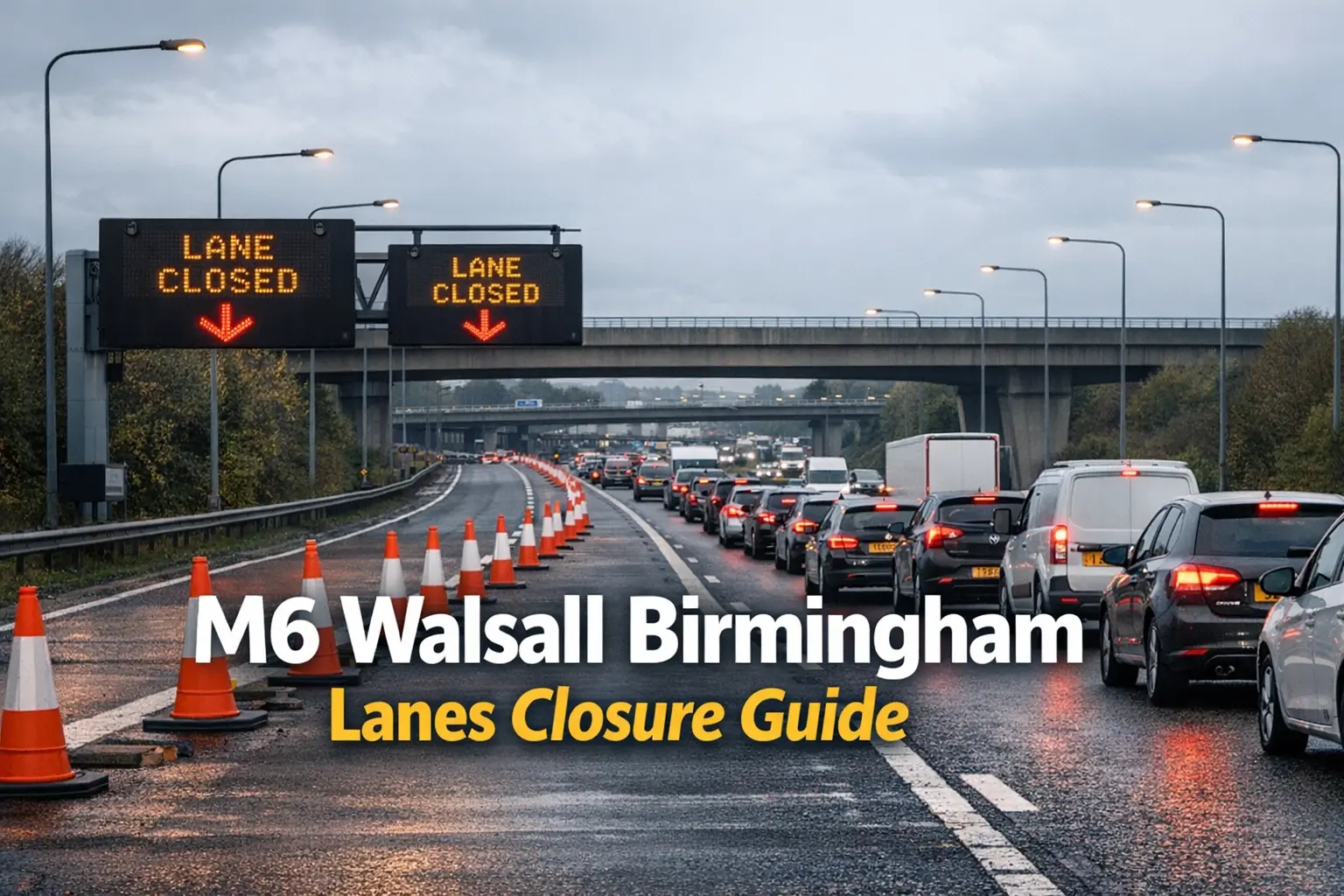
People who drive between Walsall and Birmingham will understand the experience which you described. The M6 starts to experience heavy traffic which leads drivers to move at a slow pace through a section of road work that shows no signs of stopping.
The M6 Walsall Birmingham lanes closure situation has been affecting drivers for much of 2025 and into 2026 — and it’s not going away overnight. This guide describes the reasons which lead to road closures and presents information about current closure schedules and alternative routes and methods to monitor construction progress.
Why the M6 Walsall Birmingham Lanes Close
There’s rarely just one reason. On this stretch of motorway, closures happen for three distinct causes, and they often overlap.
Planned maintenance works are the most predictable. National Highways carries out resurfacing, safety barrier replacements, and infrastructure inspections on a rolling schedule. Most of these are overnight — typically 9pm to 6am — but some larger jobs require weekend full closures too. The Bescot Viaduct, for example, has needed repeated attention due to its age and the sheer volume of traffic it carries.
Junction upgrade works have been a major factor since 2023. Junction 10 (Walsall) went through a major improvement scheme that wrapped up in March 2024. But follow-up works, signal timing adjustments, and finishing works continued well into 2025. Junction 9 also saw resurfacing works during July and August 2025, with signed diversions in place via the A4148 Bescot Road.
Accidents and incidents are the unpredictable side of things. A lorry incident near Junction 7 can shut two lanes within minutes. On 19 November 2025, a three-lane northbound closure caused delays of over 90 minutes. These incidents are impossible to plan around — but you can respond fast if you’re using the right tools.
Current and Upcoming Closures on the M6 Walsall–Birmingham Stretch
Here’s what’s been confirmed or active on this corridor recently.
National Highways scheduled M6 southbound works between Junctions 6 and 4 from 16 March to 3 April 2026, operating weeknights only from 9pm to 6am under full carriageway closures. Signed diversion routes are in place, and emergency vehicles retain access throughout.
The hard shoulder on the M6 southbound between J6 and J4A was temporarily closed on 9 March 2026 due to a broken-down vehicle, with recovery services active from early morning. Clearance was expected by 8:45am that day.
Planned overnight lane closures at Junction 11 (lanes 1 and 2 southbound) were scheduled for the night of 15–16 March 2026.
These are rolling works. Schedules can and do change at short notice, so checking before you travel is essential — not optional.
The Key Junctions You Need to Know
Understanding the layout helps you make faster decisions when something goes wrong.
Junction 6 — Spaghetti Junction is where the M6 meets the A38 in Birmingham. It’s one of the most complex interchanges in the country. Any incident here creates immediate gridlock across multiple routes.
Junction 7 — Great Barr connects the M6 to the A34, the main road into Walsall from the south. When J7 is affected, Walsall-bound traffic gets pushed onto local roads very quickly.
Junction 9 — Walsall is the dedicated Walsall exit. Resurfacing works here in summer 2025 forced traffic onto the A4148 Bescot Road diversion, adding 15–20 minutes to typical journeys.
Junction 10 — Walsall North / M54 was the focus of a major multi-year upgrade. That work is complete, but the junction still sees heavy usage and occasional signal-related delays.
Junction 10A — M54 interchange is relevant for drivers heading toward Telford or needing an alternative way around major incidents.
Best Alternative Routes When the M6 Is Closed
When lanes close between Walsall and Birmingham, your main options are:
A34 (Birmingham Road) is the most direct surface route between Birmingham and Walsall. It’s also the one everyone else defaults to, so expect it to get congested quickly during M6 closures.
A41 runs parallel to parts of the M6 and offers a reasonable alternative for drivers heading between the Black Country and Birmingham. It avoids the worst of the Spaghetti Junction chaos.
M5 southbound from Junction 1 is worth considering for drivers coming from the north. It keeps you on motorway standard roads and avoids the Walsall–Birmingham corridor entirely if your destination is south or west of Birmingham.
The M6 Toll is a genuine option that most drivers underuse. It bypasses central Birmingham completely, running from J3A (near Coventry) to J11A (near Cannock). During major M6 incidents, travel time via the Toll can be 30–40 minutes faster than sitting in traffic on the free M6.
For the J9 diversion specifically, National Highways’ official signed route uses A4148 Bescot Road → A4148 Wallows Lane → A4148 Broadway → A34 Birmingham Road to rejoin the M6 at Junction 7.
How to Get Live Updates Before and During Your Journey
The biggest mistake drivers make is checking traffic after they’ve already committed to the route. Here’s what actually works.
National Highways Traffic England (traffic.gov.uk) shows live incidents, planned closures, and diversion information. It’s the most authoritative source and is updated in real time.
Walsall Council’s roadworks page (go.walsall.gov.uk) lists all planned works affecting roads in the borough, including M6 junctions managed in coordination with National Highways.
Waze and Google Maps both incorporate live incident data and can reroute you dynamically. Waze tends to update faster on motorway incidents because of its community reporting model.
Local radio — Free Radio Birmingham and BBC WM — run traffic updates during peak hours. If you’re already in the car, this is the fastest way to get a heads-up on fresh incidents.
National Highways on X (formerly Twitter) at @HighwaysWMIDS posts closure announcements, diversion maps, and updates directly. Worth following if the M6 is part of your regular commute.
Pro Tips for Regular M6 Commuters
A few things that make a real difference if you’re on this route regularly.
Leave 20 minutes earlier than you think you need to. On the Walsall–Birmingham corridor, delays of 30–90 minutes during incidents are well documented. Buffer time isn’t being cautious — it’s being realistic.
Travel outside peak windows when possible. The worst congestion builds between 7:30–9am and 4:30–6:30pm. If your schedule allows any flexibility, even a 30-minute shift makes the M6 considerably more manageable.
Set up National Highways travel alerts. You can register for email or text notifications for specific road sections. This means you’ll know about overnight closures before you leave home the next morning.
Learn your alternative routes before you need them. The worst time to figure out where the A41 goes is when you’re already in a 3-mile queue. Map them now, drive them once on a quiet day, and you’ll have real confidence when it matters.
FAQ
What is causing the M6 Walsall Birmingham lanes closure right now?
Closures on this stretch happen for two main reasons: planned maintenance works by National Highways (usually overnight) and unplanned incidents like accidents or broken-down vehicles. Currently, overnight southbound closures between Junctions 6 and 4 are scheduled through early April 2026.
What time do the M6 lane closures between Walsall and Birmingham usually happen?
Planned maintenance closures typically run from 9pm or 10pm to 6am, Monday to Friday. Weekend full closures are sometimes used for larger works. Daytime closures are almost always incident-related.
What’s the best alternative route if the M6 is closed near Walsall?
The A34 Birmingham Road is the most direct, but gets busy fast. The A41 is a reliable secondary option. For drivers with more flexibility, the M6 Toll bypasses Birmingham entirely and is worth the cost during major incidents.
How long do M6 Walsall Birmingham closures usually last?
Planned overnight works clear by 6am most days. Accident-related closures vary — minor incidents clear in 30–60 minutes, while serious incidents involving lorries or emergency investigations can close lanes for 3–5 hours.
Where can I check for live M6 closure updates?
The most reliable sources are traffic.gov.uk (National Highways), @HighwaysWMIDS on X, and Waze or Google Maps for real-time rerouting. Local radio (BBC WM, Free Radio Birmingham) is also useful during peak hours.
Is Junction 10 Walsall still under roadworks?
The main Junction 10 improvement scheme completed in March 2024. Occasional follow-up works and signal adjustments have continued since, but the major construction phase is finished.
Will the M6 Walsall closures continue into 2026?
Yes. National Highways has confirmed scheduled works on the M6 southbound between Junctions 6 and 4 running through 3 April 2026. Further maintenance works across the West Midlands network are expected throughout the year.
Conclusion
Dealing with the M6 Walsall Birmingham lanes closure is a reality for thousands of drivers in the West Midlands. But being prepared makes it significantly less painful.
A few things worth taking away:
- Most planned closures run overnight between 9pm and 6am — check before you travel, not after
- Junction 9 and Junction 10 are the two most disruption-prone points on this stretch
- The A34, A41, and M6 Toll are your main fallbacks — know them before you need them
- National Highways Traffic England and @HighwaysWMIDS are the most reliable real-time sources
The works happening on this corridor are genuinely necessary — resurfacing, safety upgrades, and junction improvements make the road safer and more efficient long-term. In the meantime, a bit of planning goes a long way.
