
You check the news and see that the richest Americans earn 40 times more than the average worker. You wonder how anyone actually measures something that abstract. That number didn’t come from guesswork — it came from a tool called Giniä, one of the most widely used statistical measures in economics and social policy. Whether you’re a student, a policy follower, or just someone trying to understand why wealth gaps keep growing, this guide breaks down exactly what Giniä means, how it works, and why countries around the world track it so closely.
What Does Giniä Actually Mean?
Giniä refers most commonly to the Gini coefficient, a statistical formula developed by Italian mathematician Corrado Gini in 1912. It measures how evenly income or wealth is distributed across a population by producing a single number between 0 and 1. A score of 0 means perfect equality, where every person earns the same amount. A score of 1 means complete inequality, where one person holds all the income and everyone else has nothing.
In practice, no country sits at either extreme. Most fall somewhere in the middle, and that’s where the comparison gets interesting. A country with a Giniä score of 0.25 looks very different from one sitting at 0.60, even if both have the same average income on paper. The score captures the shape of distribution, not just the average, which makes it far more informative than a single income figure.
The term also appears in Finnish as a linguistic form of the name Ginia, and some users search for it in that context. However, in most global and American usage, Giniä points directly to this economic measure and its role in understanding how wealth moves through societies over time.
Why Giniä Matters for the United States
The United States had a Giniä score of 0.49 in 2024 according to the U.S. Census Bureau, up from 0.43 back in 1990. That shift over just three decades reflects one of the sharpest rises in income inequality among developed nations. To put it plainly, the gap between what the richest and poorest Americans earn has grown significantly, and it continues to widen in most regions of the country.
This matters beyond economics because higher inequality consistently links to slower social mobility, greater political polarization, and rising household debt. In 2024, the top 20 percent of earners in the U.S. took home 52.2 percent of all national income, while the bottom 20 percent received just 3.1 percent. Those numbers don’t describe poverty in isolation — they describe the distance between where people start and where they’re able to go.
State-level data reveals even sharper contrasts. Washington D.C. and New York both registered a Giniä score of 0.52 in 2024, while Utah came in at 0.42, showing the most income equality of any U.S. state. States like Wyoming, Connecticut, California, and Texas all exceeded a score of 0.50, meaning income there is concentrated more heavily among higher earners than the national average suggests.
How the Giniä Score Is Calculated
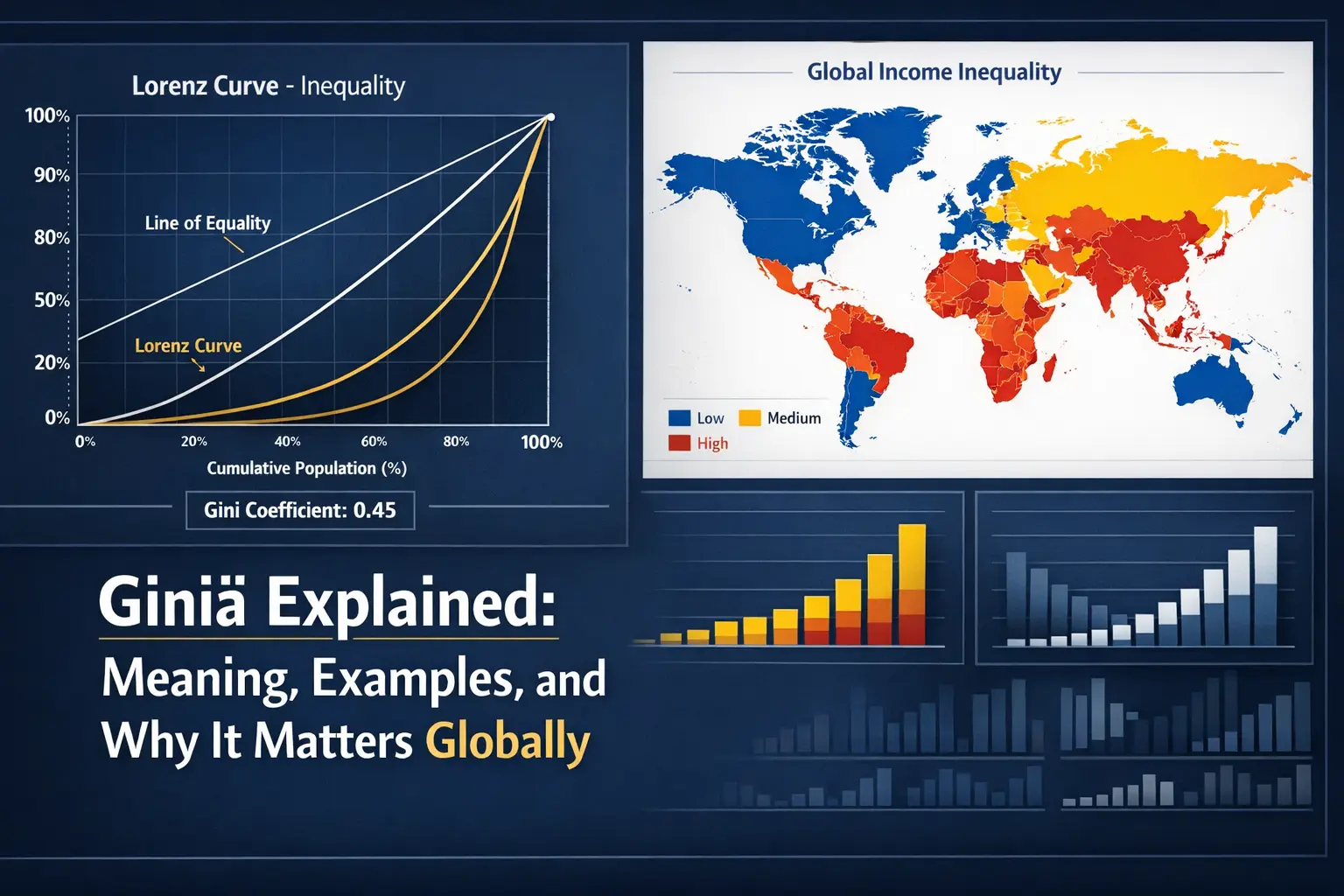
The Giniä score is built on a concept called the Lorenz curve. Imagine a graph where the horizontal axis represents the population ranked from poorest to richest, and the vertical axis shows the cumulative share of income those people hold. If income were perfectly equal, that line would run at a 45-degree angle from corner to corner. In reality, the line bows downward, and the further it bends away from that perfect diagonal, the higher the inequality.
The Gini coefficient is calculated as twice the area between the perfect equality line and the actual Lorenz curve. The wider that gap, the higher the score. A country where the bottom 50 percent of earners receive 25 percent of total income will have a different curve shape than one where they receive only 10 percent, and that difference shows up directly in the final number.
You don’t need to calculate it yourself to use it meaningfully. What matters is understanding that a rising Giniä score over time in any country signals that the benefits of economic growth are not spreading evenly. That’s the kind of early warning that governments, researchers, and policymakers rely on to decide where to act.
Real-World Examples of Giniä Around the Globe
South Africa holds the highest recorded Giniä score of any country, sitting at 63.0 when last officially measured. The richest 10 percent there hold 71 percent of all national wealth, while the poorest 60 percent collectively hold just 7 percent. More than half the population lives below the poverty line, making it one of the most unequal societies on the planet by any measure.
Nordic countries sit at the opposite end of the scale. Denmark, Finland, and Slovenia consistently score below 0.30, meaning income is spread far more evenly across those populations. These countries combine progressive taxation, strong labor protections, and universal public services in ways that keep the gap between top and bottom earners relatively narrow compared to most of the world.
The global Giniä coefficient stood at 0.50 as far back as 1820, and by 1992 it had climbed to 0.657 before improvements in emerging economies started to pull it back. Recent data shows that pandemics like COVID-19 tend to push scores up by roughly 1.5 to 1.9 percentage points in the years that follow, as lower-income workers lose jobs and assets faster than higher earners do.
What Giniä Does Not Tell You
Giniä is a powerful tool but it has clear limits that are worth knowing. Two countries can share the same score while having completely different distributions underneath. One nation might have a concentrated low-income group with a relatively equal upper class, while another might have the opposite pattern — and both could produce an identical Gini number. The score summarizes the curve but doesn’t reveal its full shape.
The measure also says nothing about a country’s overall level of wealth. Some of the world’s poorest nations have extremely high Giniä scores, while some wealthy countries also score high because of steep gaps at the top. A low score doesn’t guarantee prosperity either — it just shows that whatever income exists is more evenly distributed among the people.
Economists almost always pair Giniä with other metrics like poverty rates, median household income, and wealth concentration ratios to get a complete picture. Relying on it alone would be like judging a city’s health only by its average temperature, technically accurate but missing most of the story that actually matters.
How Governments Use Giniä in Policy Decisions
When a government watches its Giniä score rise year over year, it typically signals a need for structural intervention. Progressive taxation systems that take a higher percentage from higher earners are one of the most common tools used to reduce that gap. The U.S. Census Bureau tracks the score annually partly for this reason — it provides a consistent, comparable signal across time and across states.
Social programs like earned income tax credits, subsidized healthcare, and public education funding all serve as counterweights to inequality. When these programs are strong, post-tax Giniä scores tend to be meaningfully lower than pre-tax scores in the same country. The U.S. is a good example, where transfer payments and tax policies reduce effective inequality even though the pre-tax score remains high.
Countries that ignore persistently rising scores often face consequences that go beyond economics. Research shows that higher inequality correlates with slower GDP growth, lower social trust, higher crime rates, and reduced economic mobility across generations. Tracking Giniä regularly gives policymakers a number they can point to, debate, and use as the basis for reform before the underlying damage becomes irreversible.
Conclusion
Giniä is one of those concepts that sounds technical but has deeply practical meaning for how societies function and how everyday people experience economic life. It shows you not just how much a country earns, but how fairly that wealth is shared. The U.S. score of 0.49 in 2024 tells a story about decades of widening gaps that no single policy has fully reversed. Understanding Giniä means understanding why some people climb the income ladder easily while others stay stuck at the bottom no matter how hard they work. If you want to read economic news more critically or follow policy debates with greater confidence, knowing how to interpret this number is one of the most useful skills you can build.
Frequently Asked Questions
What is Giniä in simple terms?
Giniä is a number between 0 and 1 that measures how equally income is distributed in a country or region. A score closer to 0 means more equality, and a score closer to 1 means more inequality. It was developed by Italian statistician Corrado Gini in 1912 and remains the most widely used measure of income distribution in the world today.
Is Giniä the same as a poverty rate?
No, they measure different things. The poverty rate tells you what percentage of people fall below a set income threshold. Giniä measures how spread out income is across the entire population, regardless of whether anyone is technically poor. A country can have a low poverty rate but still score high on the Gini scale if wealth is concentrated among a small group at the top.
What is the current Giniä score for the United States?
The U.S. Census Bureau reported a Giniä score of 0.49 for the United States in 2024. This is up from 0.43 in 1990, showing a clear trend toward greater income inequality over the past three decades. State-level scores vary significantly, ranging from 0.42 in Utah to 0.52 in Washington D.C. and New York.
Which country has the highest Giniä score?
South Africa currently holds the highest recorded Gini score at 63.0. The richest 10 percent of the population there hold 71 percent of all wealth, and more than half the population lives in poverty. Nordic countries like Slovenia and Denmark sit at the opposite end with scores well below 0.30, reflecting far more equal income distribution.
Can a country’s Giniä score improve over time?
Yes, and several countries have demonstrated this. Strong social policies, progressive taxation, investment in education, and access to healthcare have all contributed to lower scores in countries that previously had higher inequality. The score is not fixed — it responds directly to the policies a government chooses and to broader changes in the economy over time.
Why do some wealthy countries still have high Giniä scores?
A high Giniä score reflects how income is distributed, not how much total wealth a country has. The United States, for example, is one of the wealthiest economies in the world but also one of the most unequal among developed nations. Factors like lower union membership, weaker wage floor protections, and large concentrations of capital among the top earners drive the score up even in high-income countries.
How often is the Giniä score updated?
Most major economies update their Gini data annually through national census bureaus or household survey programs. The World Bank and Our World in Data publish updated global comparisons regularly, though data from lower-income countries may have gaps of several years depending on when national surveys were last conducted.
