
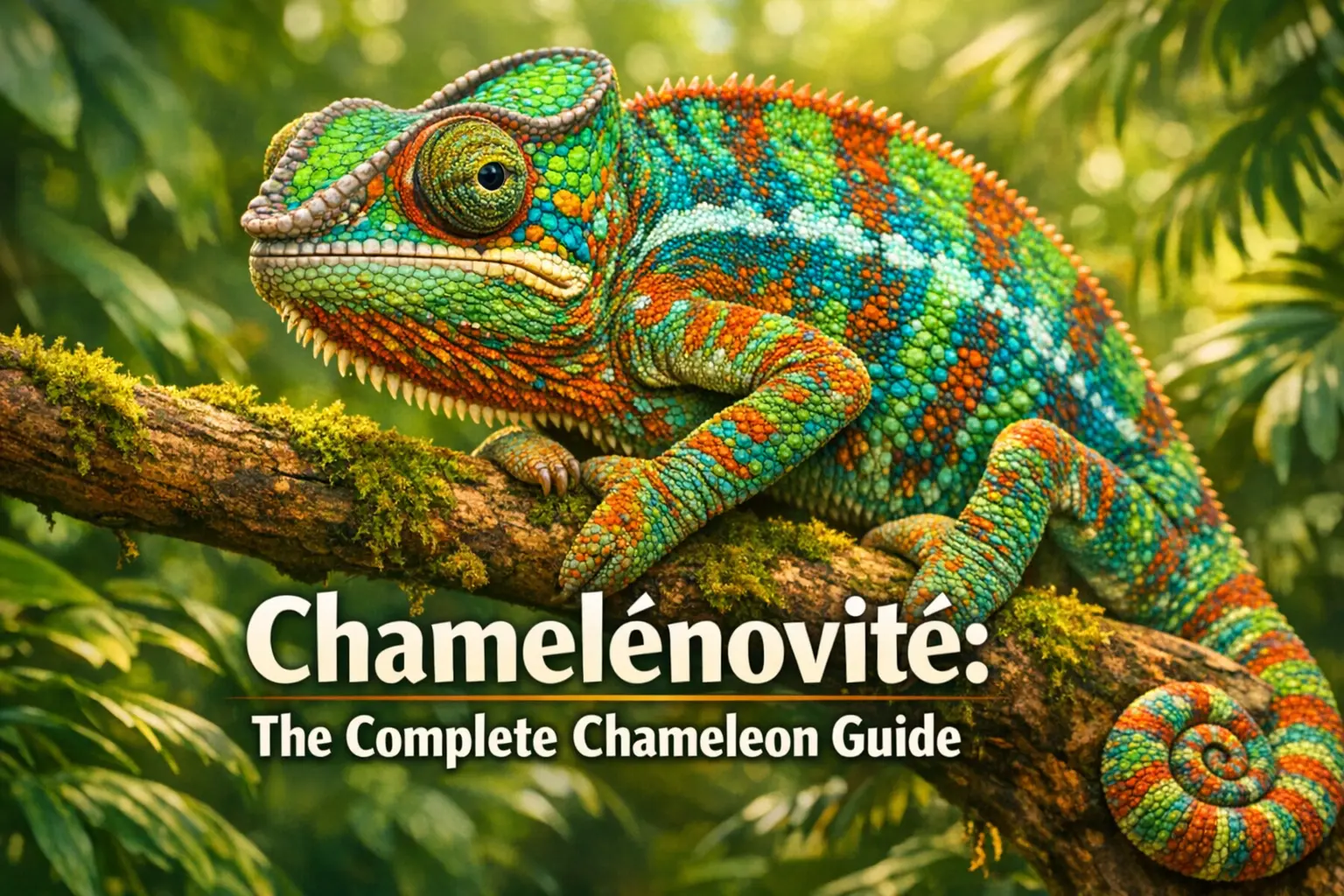
The chameleon is one of the most effective animals to stop people from walking. The slow, deliberate movement. The eyes rotating in opposite directions. The skin of the creature transforms its color from green to golden yellow and then to deep burnt orange within a few seconds.
The Slovak and Czech language term Chameleónovité designates the Chamaeleonidae family which contains all true chameleons. This reptile family contains over 200 recognized species which makes it one of the most distinct reptile families in existence. Most people only understand about 10 percent of what makes them truly remarkable.
The guide presents accurate biological information together with common myths which should be eliminated and essential species information plus details about their actual endangered status.
What Is Chameleónovité? The Family Explained
Chameleónovité refers to the family Chamaeleonidae — lizards belonging to the order Squamata, the same broad group as snakes. But beyond that, they’ve evolved along a completely separate track from almost every other reptile.
They’re Old World lizards, meaning they’re native to Africa, Madagascar, the Middle East, India, and parts of southern Europe. They didn’t naturally colonise the Americas, Australia, or most of Asia.
The family splits into several genera, each with distinct traits:
- Chamaeleo — the most widespread, found across Africa and parts of the Middle East
- Furcifer — endemic to Madagascar, with some of the most dramatically coloured species
- Calumma — also Madagascar-exclusive, often with distinctive casques and crests
- Brookesia — miniature ground-dwelling species, some barely 3cm long
- Trioceros — includes the horned chameleons, recognisable by their distinctive facial projections
- Rhampholeon — small forest specialists across central Africa
Madagascar alone hosts nearly half of all known chameleónovité species. Most of them exist nowhere else on Earth.
How Chameleónovité Actually Change Colour
The colour-change ability is famous. The explanation most people know — “they change to match their background” — is only partially true.
The actual mechanism involves two layers of specialised skin cells working together. Chromatophores contain pigment that produces reds, yellows, and browns. Beneath them, iridophores contain tiny crystal nanostructures that bend and reflect light, producing blues, greens, and metallic sheens.
When a chameleon is relaxed, the nanocrystals in the iridophores are packed tightly together and reflect short-wavelength blue light. When the animal is excited or stressed, the crystals spread apart, shifting the reflected light toward longer wavelengths — yellows and reds.
This means colour change in chameleónovité is primarily about communication and emotion, not camouflage. A male in a territorial dispute goes bright. A stressed animal darkens. A cold chameleon turns darker to absorb heat faster. Camouflage is part of it, but it’s far from the whole story.
The Physical Adaptations That Set Chameleónovité Apart
Chameleons are built for a very specific lifestyle — slow, precise movement through trees — and almost every part of their anatomy reflects that.
Zygodactylous feet are the foundation. Their toes are fused into two opposing groups, creating a pincer-like grip that locks onto branches with extraordinary security. You’re not pulling a chameleon off a branch easily.
The prehensile tail functions as a fifth limb. It wraps around branches and holds, giving the animal a secure anchor while it reaches for food or navigates narrow perches. Most chameleónovité rarely need to come down to the ground.
Laterally compressed bodies — flat like a leaf — let them move through dense foliage while staying balanced. The flattened shape also helps them present a smaller profile to predators when viewed head-on.
Head casques, crests, and horns vary enormously between species and serve social functions. Male Jackson’s chameleons (Trioceros jacksonii) have three distinct horns used in combat. Many species use crest size as a signal of dominance.
Independent eye movement gives chameleónovité nearly 360° vision. Each eye moves and focuses separately, letting the animal monitor threats behind while tracking prey ahead. When prey is spotted, both eyes lock on together for stereoscopic depth perception — which feeds directly into their hunting method.
How Chameleónovité Hunt: The Ballistic Tongue
The tongue is one of the most impressive biological mechanisms in the animal kingdom.
At rest, it’s coiled inside the skull, compressed around a bony structure called the hyoid. When a chameleon fires, powerful accelerator muscles launch the tongue forward at up to 8,500 cm/s². The tip, covered in thick sticky mucus, makes contact with prey and adheres instantly. The tongue then retracts back into the mouth — entire sequence complete in under 0.07 seconds in some species.
In many chameleónovité, the tongue reaches 1.5 to 2 times the animal’s body length. A 30cm chameleon can reliably catch prey 45–60cm away.
They’re primarily insectivorous — beetles, flies, crickets, and other invertebrates make up most of the diet. Larger species occasionally take small birds or other lizards. Brookesia and Rhampholeon species, being much smaller, feed on tiny springtails and mites.
Notable Species Worth Knowing
With 200+ species, a few stand out for specific reasons.
Parson’s chameleon (Calumma parsonii) is the largest species by mass — males can reach 68cm and live up to 10 years in the wild, unusually long for a lizard. It’s found only in eastern Madagascar.
Brookesia micra, discovered in 2012, was for several years the world’s smallest known reptile. Adults measure around 29mm tip to tail. It was found on the tiny island of Nosy Hara, off northern Madagascar.
Veiled chameleon (Chamaeleo calyptratus) is one of the most commonly kept as a pet. It tolerates captivity better than most chameleónovité species and breeds reasonably well in captivity, making it the standard starting point for reptile keepers.
Panther chameleon (Furcifer pardalis) from Madagascar is arguably the most visually spectacular, with males displaying electric blue, red, orange, and green patterns depending on their locale population. Different colour morphs correspond to specific regions of Madagascar — a Nosy Be panther looks completely different from an Ambilobe one.
Chameleónovité in the Wild: Habitat and Behaviour
Most chameleónovité are solitary and territorial. Outside of mating, encounters between individuals — especially males — typically result in colour displays, body flattening, and sometimes physical combat.
They’re predominantly diurnal — active during the day, sleeping on exposed branches at night. At night, their skin lightens significantly, which may help them thermoregulate or signal their location to potential mates.
Many species are highly specific about habitat. The Usambara two-horned chameleon (Kinyongia multituberculata), for example, exists only in a few square kilometres of Tanzanian forest. Remove that forest and the species is gone — there is no backup population elsewhere.
This extreme habitat specificity is one reason why deforestation hits chameleónovité harder than most animal groups.
Conservation: Why Over Half of Chameleónovité Are Threatened
The IUCN Red List currently classifies more than 50% of chameleon species as threatened, vulnerable, or endangered. That’s a striking number.
The main drivers are:
- Deforestation — particularly in Madagascar, where logging and land clearance have destroyed huge areas of native forest
- Illegal wildlife trade — dozens of species are collected for the exotic pet market, often unsustainably
- Climate change — altering rainfall patterns and temperatures in ways that directly affect cold-blooded animals dependent on specific thermal ranges
- Agricultural expansion — converting forest to farmland eliminates habitat permanently
Madagascar is the most critical zone. The island has lost approximately 90% of its original forest cover. The chameleónovité species that evolved there over millions of years are running out of space rapidly.
Some species have responded well to captive breeding programmes — the panther and veiled chameleons are now largely bred in captivity rather than wild-caught. But many rarer species remain poorly studied and unprotected.
Keeping Chameleónovité as Pets: What You Should Know First
Chameleons are among the most demanding reptiles to keep well. Anyone considering one should understand this clearly before buying.
They’re not handleable pets in the way that bearded dragons or corn snakes are. Most chameleónovité find handling stressful, and chronic stress causes serious health problems. They’re animals to observe, not interact with.
Basic requirements for a healthy captive chameleon:
- Enclosure — screen-sided (not glass) to allow airflow, minimum 60x60x120cm for adult veiled or panther chameleons
- Lighting — UVB lighting is non-negotiable, typically 10–12 hours per day
- Temperature — a basking spot of 29–32°C, ambient temperature of 22–26°C, with a night drop to 18–20°C
- Hydration — they don’t drink from bowls; they drink water droplets from leaves. Drip systems or regular misting (2–3 times daily) are essential
- Diet — live insects only, gut-loaded and dusted with calcium and vitamin D3 supplements
Veterinary care from a reptile specialist is also important. Chameleons mask illness well, and by the time visible symptoms appear, the problem is often advanced.
If you’re new to reptiles, start elsewhere and return to chameleónovité once you have solid experience.
FAQ
What does chameleónovité mean?
It’s the Slovak and Czech word for the biological family Chamaeleonidae — the group that includes all true chameleons. The term translates roughly as “chameleon family” or “chameleon-like” and is used in Central European languages the way English uses “Chamaeleonidae” in scientific contexts.
How many species of chameleónovité are there?
Over 200 recognised species, with new ones still being described. Madagascar hosts the highest concentration — nearly 100 species — most of which are found nowhere else on Earth. Africa is the second major centre of diversity.
Do chameleónovité really change colour for camouflage?
Partly, but it’s not the main reason. Colour change is primarily used for communication — displaying dominance, readiness to mate, or stress — and for thermoregulation. Camouflage is a secondary function. Their resting colours already tend to match their environment reasonably well.
What is the smallest chameleónovité species?
Brookesia micra, discovered in Madagascar in 2012, held the title of world’s smallest reptile for several years. Adults measure around 29mm. It lives in leaf litter on the tiny island of Nosy Hara.
Are chameleónovité good pets for beginners?
No. They’re one of the more difficult reptiles to keep successfully. They require precise humidity, temperature, and UVB conditions, they don’t tolerate handling well, and they hide illness until it’s serious. Beginners are better served starting with hardier species.
Why are so many chameleónovité endangered?
Primarily due to habitat destruction — especially deforestation in Madagascar — combined with illegal collection for the pet trade and climate change. Over half of all species are currently classified as threatened or endangered by the IUCN.
What do chameleónovité eat in the wild?
Mostly insects — beetles, grasshoppers, flies, termites, and other invertebrates. Larger species occasionally eat small birds or lizards. Miniature species like Brookesia feed on tiny springtails, mites, and small insects invisible to the naked eye.
Conclusion
Chameleónovité are not just pretty reptiles with a party trick. They’re a deeply specialised family that’s spent tens of millions of years evolving some of the most sophisticated biological systems in the animal kingdom.
A few things worth taking away:
- Colour change is primarily about communication and temperature — not just camouflage
- Over 200 species exist, nearly half of them found only in Madagascar
- More than 50% of chameleónovité species are currently threatened or endangered
- They’re fascinating to observe but among the most demanding reptiles to keep responsibly
Whether you’re a reptile keeper, a wildlife enthusiast, or simply someone who found this word in a strange corner of the internet — chameleónovité deserve more than a passing glance.
