
Tuesday, 26 August 2025. Most people in Berwickshire started their morning the usual way — until they turned on the tap.
Some got nothing at all. Others got a trickle of brown water. A few got water that looked and smelled wrong. And within hours, the message came through from Scottish Water: don’t drink it, don’t cook with it, don’t brush your teeth with it. The Berwickshire tap water warning had begun, and nobody was entirely sure how long it would last.
What followed was five days that exposed how completely dependent communities are on infrastructure most people never think about — and how quickly that dependency becomes a crisis when something fails. Around 6,000 properties across a wide stretch of Berwickshire were affected. Shops ran out of bottled water within hours. Businesses shut their doors. Farms struggled to keep livestock watered. And Scottish Water scrambled to respond to what it would later describe as one of the biggest and most challenging incidents it had ever faced in the Borders.
This is the full story of what happened, why it happened, and what every resident in the affected area should know — including the compensation process that most people still haven’t used.
What Caused the Berwickshire Tap Water Warning
The fault originated at Rawburn Water Treatment Works, located near Longformacus in the Lammermuir Hills outside Duns. Rawburn is the primary treatment facility supplying water to a wide area of Berwickshire, processing approximately seven million litres of water every single day under normal operating conditions.
On Tuesday afternoon, 26 August, Scottish Water engineers detected a problem. A section of water main within the treatment works had become damaged — early reports described it as a disintegrated pipe — and there were immediate concerns that contamination may have entered the treatment process. Scottish Water made the decision to shut the works down entirely while emergency repairs were carried out.
This was not a minor decision. Rawburn supplies around 10,000 homes across Berwickshire. Shutting it down while simultaneously trying to repair the damage and maintain some level of supply to 10,000 properties is an enormously complex engineering and logistics problem. The fact that it happened during the driest summer the region had seen in years — with water storage already running lower than usual — made every aspect of the response harder.
Questions were raised in the days following the incident about how early Scottish Water knew a problem was developing. There were reports of water tankers arriving at Rawburn during the week before the fault was officially declared, raising the possibility that engineers were already aware of deteriorating conditions before the public warning was issued. Scottish Water confirmed the fault was detected on the Tuesday afternoon but did not address the earlier tanker activity in detail.
What’s clear is that once the fault was declared, the response was rapid. Engineers worked through Tuesday night installing overland pipes to bypass the damaged section of water main. Tank cleaning began simultaneously. And Scottish Water issued its public warning to residents — including the instruction not to use tap water for drinking, cooking, making baby formula, or cleaning wounds.
Which Areas Were Affected by the Berwickshire Water Warning
The disruption spread across a substantial part of Berwickshire. The affected communities included Duns, Eccles, Coldingham, Chirnside, Paxton, Coldstream, Burnmouth, Lamberton, Drone Hill, Birgham, Whitsome, Swinton, and Leitholm.
Within that wider area, approximately 275 properties received a more serious “do not use” notice rather than the general “do not drink” advisory. These were properties in the TD11 postcode area closest to the Rawburn works itself, where the risk of contamination was assessed as highest. Those households were advised not to use tap water for any purpose at all.
The remaining 6,000 affected properties were under the broader Berwickshire tap water warning — meaning tap water could be used for flushing toilets and potentially for showering, but not for any purpose involving consumption.
The geographic spread of the affected area reflects how centralised Berwickshire’s water supply infrastructure is. Unlike urban areas where multiple treatment facilities can serve overlapping zones, rural Berwickshire is heavily dependent on Rawburn. When Rawburn went down, there was no nearby backup facility that could immediately pick up the slack. The entire response had to be built around tankers, overland pipes, and round-the-clock engineering work.
The 370 miles of water mains and nine storage tanks that make up Berwickshire’s network also complicated recovery. Recharging a network that size after a shutdown causes its own problems — pressure surges, secondary bursts, sediment disturbance. Each of those complications created additional delays in getting supplies back to normal.
The Five-Day Timeline: What Happened When
Understanding the sequence of events matters because the timeline reveals both the scale of the response and the extent to which residents were left without clear information at several critical points.
Tuesday, 26 August — The fault is detected. Engineers find a damaged section of pipe at Rawburn. The works are shut down. Overnight, teams install overland supply pipes to bypass the damaged section and begin cleaning water storage tanks. The public warning goes out.
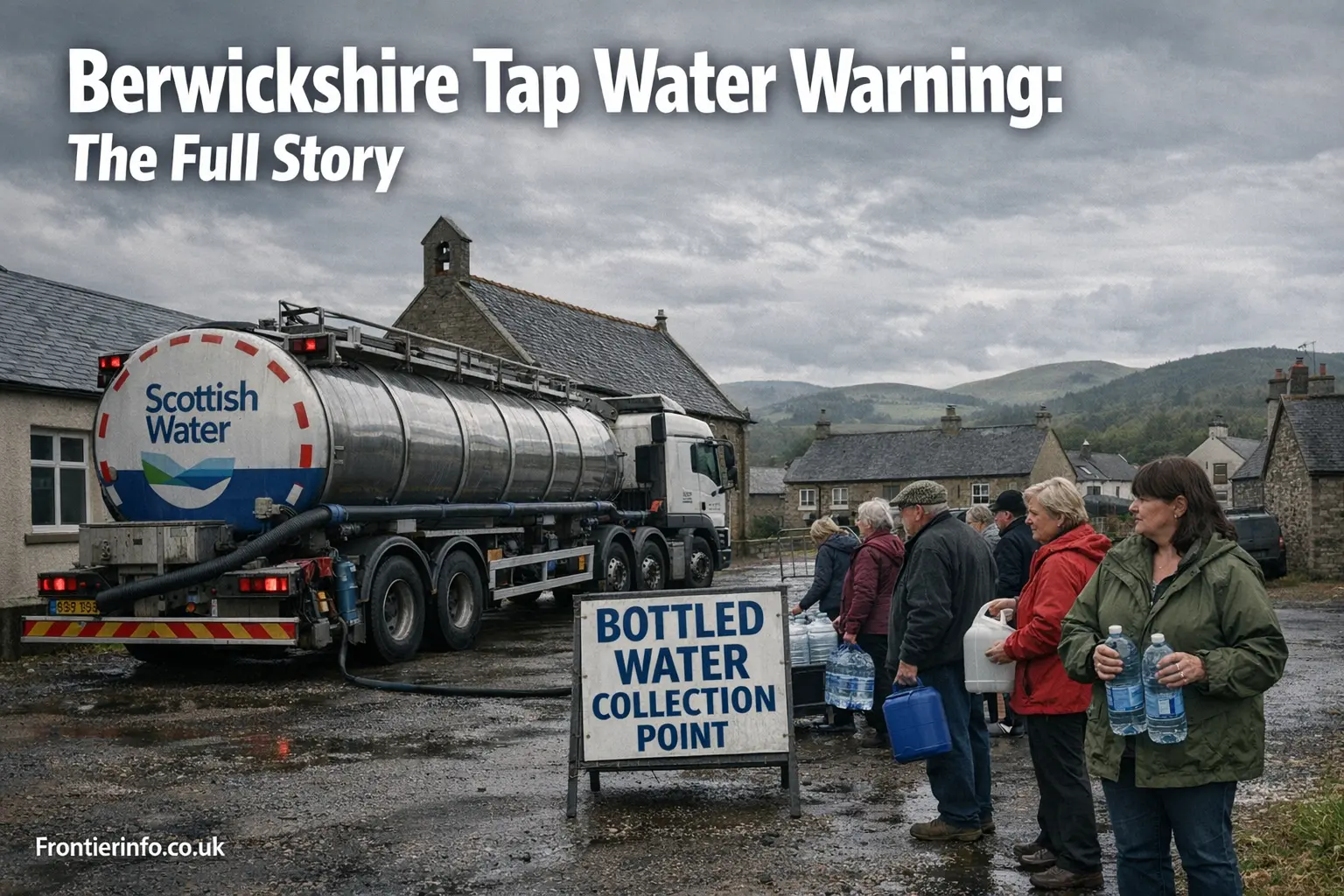
Wednesday, 27 August — The immediate crisis peaks. Residents across Berwickshire wake up with no water, or severely reduced supply. Shops in Duns and surrounding towns sell out of bottled water within hours. The “do not use” notice for 275 properties in TD11 is issued as a precaution. Scottish Water sets up an emergency bottled water collection point at Berwickshire High School car park in Duns. The “do not drink” advisory for the wider 6,000 properties remains in place.
Businesses begin to close. Duns-based childcare service Adventure Begins announces it’s shutting for the day. Charity shop BAVs Berwickshire closes. Cafés and restaurants can’t operate without water. Some hairdressers close. The economic impact begins accumulating immediately.
Scottish Water lifts the “do not use” notice for the 275 TD11 properties by Wednesday evening, confirming that supplies to those homes have been restored and are safe. But the broader Berwickshire tap water warning for the wider 6,000 properties remains in force.
Thursday and Friday, 28–29 August — Tanker operations intensify. More than 20 water tankers are running 24 hours a day. Additional staff — over 100 in total — are drafted in from Scottish Water operations in Aberdeen and Glasgow. Specialist equipment arrives. The scale of the response is significant enough that John Griffen, Scottish Water’s response lead, describes it publicly as one of the biggest and most challenging incidents the company has ever faced in the Borders.
The tanker convoy is constant. Villages that are normally quiet overnight hear lorries running through at two and three in the morning. Residents accept this because the alternative is no water at all.
Saturday and Sunday, 30–31 August — Supplies begin returning. Scottish Water begins restoring supply progressively across the network. But the water coming through in many areas is discoloured — brownish, sometimes reddish. Scottish Water explains this is sediment disturbed during the network recharging process and advises residents to run their cold tap at a slow trickle until the water runs clear.
Not everyone trusts this. Having been told for several days not to drink the water, the instruction to now run the tap and trust it comes back clean is a difficult mental switch for many residents to make. Some households continue using bottled water for several more days as a precaution.
By Sunday 31 August, Scottish Water considers the supply situation largely resolved. The Berwickshire tap water warning has been in force for five days.
How It Hit Businesses and Farms
The economic impact of the Berwickshire tap water warning spread well beyond individual households, and some of its worst effects fell on businesses and farms that had no practical alternatives.
For hospitality businesses — pubs, cafés, restaurants, hotels — the crisis was immediate and total. You cannot run a food or drink business without water. Not for cooking, not for washing equipment, not for making beverages, not for basic hygiene. Businesses that had no way to bring in their own supply had no choice but to close their doors and lose those trading days entirely.
The Three Mariners pub, one of the most referenced local businesses in media coverage of the incident, experienced serious disruption to its trade. The combination of inaccessible roads, reduced footfall from customers avoiding the area, and the absence of usable water supply made normal operation impossible.
Childcare settings, healthcare-adjacent businesses, and any operation with strict hygiene requirements felt the restrictions particularly acutely. Adventure Begins, the childcare provider, made the responsible call to close rather than operate with compromised water safety. That decision protected children in their care but meant families scrambling to find alternative arrangements at short notice.
Agricultural operations faced a different kind of pressure. Livestock need water every day. Dairy operations require clean water in large quantities for equipment washing and cooling processes. Some farmers in the affected area had to source their own water supplies independently — borrowing from neighbouring farms outside the affected zone or bringing in their own tankers — just to keep their herds and operations running.
The summer drought context made all of this worse. Water storage across the region was already below seasonal norms when the Rawburn fault occurred. Farms that might normally have drawn on stored rainwater or alternative sources found those reserves reduced. The drought conditions that SEPA escalated to a formal warning for the Berwickshire area in early September were not a coincidence — they were part of the same environmental pressure that made the Rawburn incident harder to manage and slower to resolve.
The Compensation Process: What Residents Are Owed and How to Claim

Scottish Water wrote to all 6,000 affected properties in early September 2025, explaining the compensation that affected customers were entitled to and how to claim it.
The compensation amount is £45 per affected property. This breaks down as £30 for the first 12 hours of unplanned supply interruption and a further £15 for the additional 12-hour period — reflecting the provisions in Scottish Water’s Code of Practice for unplanned supply interruptions. The payment is acknowledged by Scottish Water as partial compensation rather than full restitution — more of an apology payment than a genuine reflection of the disruption caused.
By mid-September, only around 15% of the 6,000 affected properties had submitted claims. Scottish Water initially described this as residents being unaware of the process, but the more likely explanation is a combination of factors: some residents found the claims process inconvenient, some felt £45 was too small to be worth the effort, and some simply wanted to move on from an unpleasant week rather than engage with more paperwork.
Recognising the low uptake, Scottish Water took the unusual step of sending staff door-to-door across the affected communities between 18 and 28 September, with mobile customer information units at fixed locations to help residents submit claims in person. Staff visited locations including the car park at Berwickshire High School in Duns, Swinton Primary School, Main Street in Leitholm, and Paxton Village Hall.
At each visit point, Scottish Water staff also encouraged residents to sign up to two important services. The Priority Service Register provides additional support to vulnerable customers — those with medical conditions, disabilities, or who are elderly — during future supply disruptions, including priority notification and direct assistance. The Text Alert Service sends updates directly to your mobile phone when supply issues are detected in your area, giving you advance warning rather than waking up to no water.
If you were affected by the Berwickshire tap water warning and haven’t yet claimed compensation, you can still do so. Contact Scottish Water at customer.concerns@scottishwater.co.uk with your address and details of the disruption you experienced. Include information about the dates your supply was affected and any specific impacts — for example, if you were among the 275 properties under the stricter “do not use” notice, that’s relevant context. The claims process was designed to be straightforward, and Scottish Water has committed to processing claims from all affected customers.
Businesses with larger financial losses should note that the standard £45 compensation is unlikely to reflect actual damages for commercial operations. Affected businesses may wish to seek independent advice about whether additional claims are possible, potentially through their business insurance or directly with Scottish Water’s commercial team.
What Residents Should Do to Prepare for Future Warnings
The Berwickshire tap water warning was unusual in its scale but not in its category. Water supply disruptions happen across Scotland and the UK every year. The difference here was the severity and duration — but the practical preparations that would have helped in August 2025 are the same preparations that help in any supply disruption.
Register for Scottish Water’s Text Alert Service. This is the most important single action. When a supply issue is detected in your area, you receive a text message directly. In August 2025, residents in Chirnside and other communities reported hearing nothing from Scottish Water for the first several hours of the crisis. The text alert service exists specifically to close that gap. You can register through Scottish Water’s website or by asking a customer service representative to add you.
Sign up to the Priority Service Register if you or someone in your household is vulnerable. This includes elderly residents, people with medical conditions requiring clean water for treatment, those with disabilities, and households with very young children. Priority Service Register customers receive additional support during supply disruptions — earlier notification, direct assistance from Scottish Water staff, and priority access to emergency supplies.
Keep a 48-hour emergency water supply at home. This sounds extreme until you spend a day trying to buy bottled water from empty supermarket shelves. A basic emergency supply means two litres per person per day, stored in sealed bottles in a cool dark location. For a household of four, that’s 16 litres — about four large bottles. Rotate your stock every six months. It costs next to nothing and removes the immediate panic when a warning is issued.
Know which foods can be made without tap water. During the crisis, many residents discovered that they hadn’t thought about what they could actually eat. Sealed packaged foods, tinned goods, and shelf-stable items that don’t require cooking with water become your practical options during a “do not cook” warning. A basic household emergency food stock that doesn’t rely on tap water is worth having regardless of water supply concerns.
Understand what the different warning levels mean. There’s an important difference between “do not drink,” “do not cook,” and “do not use” warnings. A “do not drink” advisory means tap water can still be used for washing and flushing but not for consumption. A “do not cook” warning — which Councillor Mark Rowley noted he’d never seen before August 2025 — means even heating the water doesn’t make it safe. A “do not use” notice is the most serious level, meaning the water should not contact skin or surfaces where food is prepared. Knowing these distinctions helps you make practical decisions rather than discarding water that’s actually safe for some uses.
Keep the Scottish Water emergency number accessible. The 24-hour helpline is 0800 077 8778. This is the number for supply issues, not gas or other emergencies. If you notice a burst pipe, discoloured water, or any change in your supply, calling immediately — rather than waiting to see if it resolves — gives Scottish Water earlier warning and potentially faster response times.
The Drought Connection: Why This Could Happen Again
One element of the Berwickshire tap water warning that received relatively little attention in the immediate coverage was the wider environmental context in which it occurred.
August 2025 was extremely dry across the Borders. By the time the Rawburn fault occurred, water storage levels across the Berwickshire network were already below seasonal norms. SEPA issued a formal drought warning for Berwickshire and surrounding areas in early September, citing significantly reduced river flows and groundwater levels.
This matters for two reasons. First, it made the immediate response to the Rawburn fault harder — lower storage meant less water available from the network’s nine storage tanks to supplement tanker supplies during the repair period. Second, it raises a question about the underlying condition of infrastructure that’s operating under increased stress.
The damaged pipe at Rawburn is the immediate cause of the August 2025 incident. But ageing infrastructure combined with increased demand and reduced rainfall — both features of climate patterns that are likely to intensify in coming decades — creates conditions where faults become more frequent and harder to manage when they occur.
Scottish Water has not yet published full findings from its investigation into the Rawburn fault. The specific cause of the pipe damage, whether it relates to age, ground conditions, drought-related pressure changes, or something else entirely, hasn’t been publicly confirmed. That investigation was still ongoing as of mid-September 2025.
For residents, the practical implication is that the Berwickshire tap water warning of August 2025 may not be the last disruption of its kind. The region’s geography, its dependence on centralised treatment infrastructure, and the environmental pressures now affecting water storage all point toward the possibility of further incidents. Preparation matters.
Questions That Still Need Answering
Several questions raised during and immediately after the crisis haven’t received clear public answers from Scottish Water.
The first is the timeline question. Reports of tankers arriving at Rawburn during the week before the fault was officially declared raise legitimate concerns about how early Scottish Water was aware of potential problems and whether earlier action could have prevented or reduced the scale of the disruption. Scottish Water’s position — that the fault was detected on Tuesday afternoon — doesn’t fully address why tankers were already on site.
The second is the infrastructure question. Was the damaged pipe at Rawburn an isolated fault or part of a broader pattern of ageing infrastructure across the treatment works? If the latter, residents and local councillors have a legitimate interest in understanding what Scottish Water’s plans are for addressing the underlying condition of the facility.
The third is the communication question. Multiple residents, including Robert French from Chirnside who spoke publicly about the issue, reported receiving no direct communication from Scottish Water during the early hours of the crisis. In an era when mobile alerts and postcode-based notification systems are standard tools for utility companies, the absence of proactive communication to affected households is a reasonable criticism.
The fourth is the compensation adequacy question. £45 is a formal acknowledgement of disruption, not meaningful compensation for a week without safe water. For households that spent significantly more than that on bottled water, for businesses that lost trading days, and for farms that had to source emergency supplies independently, the standard payment doesn’t come close to reflecting actual losses. Scottish Water’s Code of Practice sets the minimum payment level, but companies have discretion to offer more in exceptional circumstances. Whether this incident — which Scottish Water itself called one of the biggest in its Borders history — qualified for exceptional treatment is a question that’s been largely ignored.
FAQ
What was the Berwickshire tap water warning?
The Berwickshire tap water warning was issued on 26 August 2025 after a fault at Rawburn Water Treatment Works near Duns disrupted water supplies to around 6,000 properties across Berwickshire. Residents in areas including Duns, Chirnside, Coldstream, Coldingham, and surrounding communities were advised not to drink, cook with, or use tap water for consumption. The warning remained in force for approximately five days before supplies were progressively restored.
Which areas were affected by the Berwickshire water warning?
The affected areas included Duns, Eccles, Coldingham, Chirnside, Paxton, Coldstream, Burnmouth, Lamberton, Drone Hill, Birgham, Whitsome, Swinton, and Leitholm. Around 275 properties in the TD11 postcode area closest to Rawburn received a stricter “do not use” notice, while the broader 6,000 properties were under the “do not drink” advisory.
What caused the Rawburn Water Treatment Works failure?
A damaged section of water main within the Rawburn works caused the fault. Early reports described it as a disintegrated pipe, with contamination fears prompting Scottish Water to shut the works down entirely while emergency repairs were carried out. The full investigation results were still pending as of mid-September 2025.
How much compensation are Berwickshire water warning residents entitled to?
Scottish Water offered affected customers £45 per property under its Code of Practice for unplanned supply interruptions. This comprises £30 for the first 12 hours and £15 for the additional 12 hours. To claim, contact Scottish Water at customer.concerns@scottishwater.co.uk with your address and details of the disruption you experienced.
How long did the Berwickshire tap water disruption last?
The water warning was issued on Tuesday 26 August 2025. Scottish Water began progressively restoring supplies from Saturday 30 August, with the situation largely resolved by Sunday 31 August — a period of approximately five days. Some households experienced discoloured water for several further days during the network recharging process.
How many tankers did Scottish Water use during the Berwickshire crisis?
Scottish Water deployed more than 20 water tankers running 24 hours a day throughout the emergency. Over 100 additional staff were brought in from Scottish Water operations in Aberdeen and Glasgow, along with specialist equipment. In total, the tanker operation moved more than 12 million litres of water by road over the course of the response.
What should Berwickshire residents do to prepare for future water warnings?
Register for Scottish Water’s Text Alert Service for automatic notification of supply issues in your area. Sign up to the Priority Service Register if you or a household member is vulnerable. Keep a basic 48-hour emergency water supply at home — two litres per person per day in sealed, rotated bottles. Know the difference between “do not drink,” “do not cook,” and “do not use” warning levels. And keep Scottish Water’s 24-hour helpline number — 0800 077 8778 — easily accessible.
Conclusion
The Berwickshire tap water warning of August 2025 wasn’t just an inconvenient week. It was a reminder of how much daily life depends on infrastructure that most people don’t think about until it fails.
A few things worth taking away:
- The Rawburn fault left 6,000 Berwickshire properties without safe water for up to five days — Scottish Water described it as one of the biggest incidents in its Borders history
- Compensation of £45 per property is available to all affected households — only around 15% had claimed by mid-September 2025, so many residents are still owed money
- Registering for Scottish Water’s Text Alert Service and Priority Service Register are the two most practical steps any resident can take before a future disruption occurs
- The combination of ageing infrastructure and drought conditions suggests this may not be the last significant disruption affecting Berwickshire water supplies
The communities affected handled the crisis with considerable resilience — neighbours sharing supplies, volunteers helping distribute water, local businesses adapting as best they could. That community response was genuinely impressive. But the best preparation for the next incident is making sure Scottish Water’s own early warning systems reach residents directly, before the situation becomes a crisis.
