
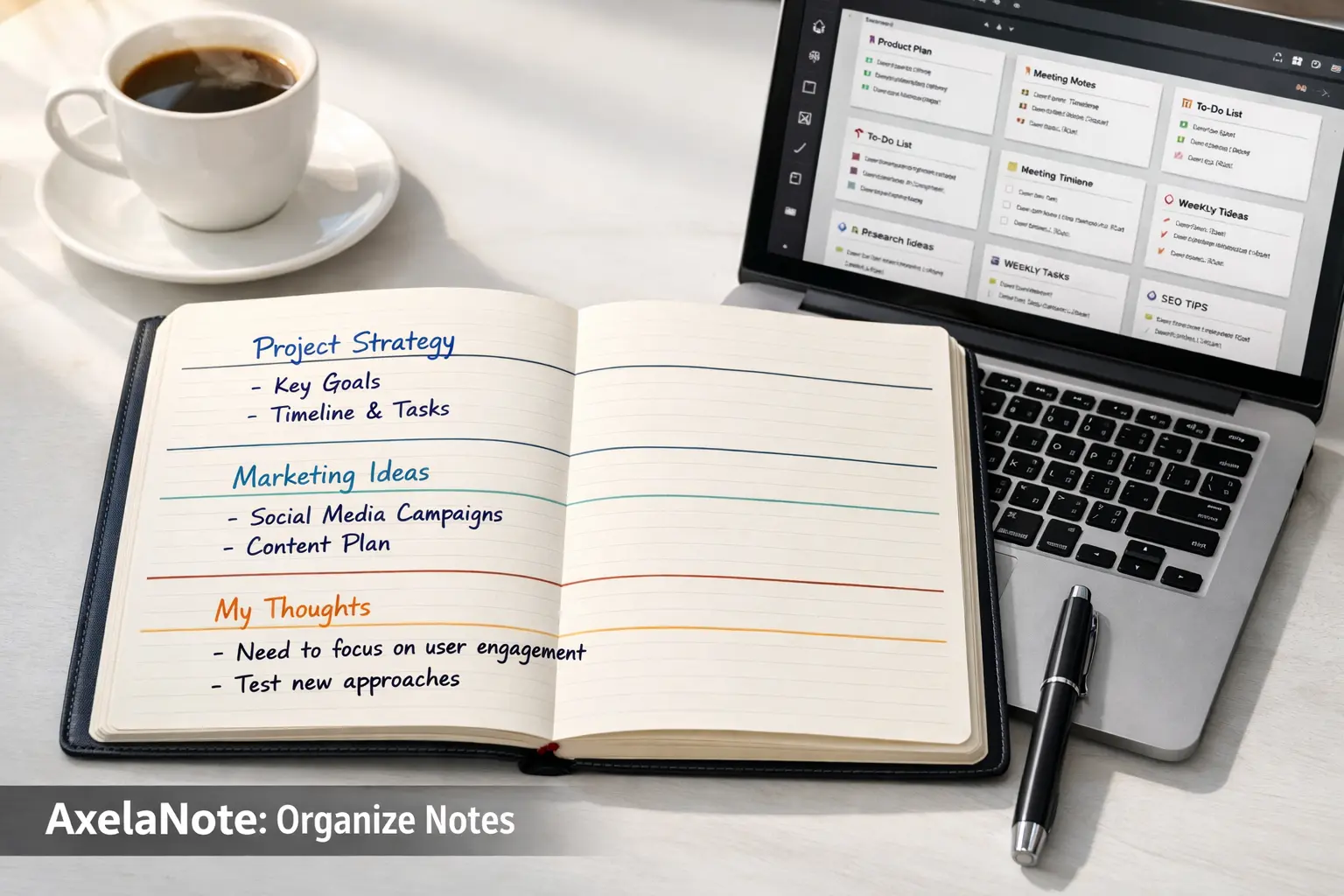
Most students take notes. Very few actually use them. You sit in a lecture, scribble everything the professor says, fill three pages of a notebook, and then close it. Two weeks later, when the exam approaches, you open that same notebook and feel like you’re reading it for the first time. Sound familiar? That’s not a memory problem. That’s a note-taking problem — and AxelaNote is built specifically to fix it.
AxelaNote is more than just a method for writing things down. It’s a structured approach to how you capture ideas, connect concepts, and review information in a way that actually sticks. Whether you’re a university student drowning in lecture content or a professional trying to stay on top of meetings and learning materials, AxelaNote offers a system that transforms scattered notes into something genuinely useful.
What AxelaNote Actually Is — And Why It’s Different
A lot of people hear “AxelaNote” and think it’s just another note-taking app or productivity tool. It’s not. AxelaNote is a note-taking methodology — a structured system that can be applied using any tool you already have, whether that’s a physical notebook, Notion, Evernote, Google Docs, or even a plain Word document.
The core idea behind AxelaNote is concept hierarchy. Instead of writing notes linearly — just copying what the teacher says in the order they say it — AxelaNote asks you to capture information in layers. You start with the main idea, then support it with explanations, then add your own personal insight or question at the bottom. These three layers work together to build what learning scientists call “elaborative encoding,” which simply means connecting new information to what you already know. When you do that, your brain holds onto it far better.
What makes AxelaNote stand out from traditional methods like the Cornell method or mind mapping is the flexibility it offers. It doesn’t require a specific page layout or a particular app. The structure lives in how you think about information, not in the format of your notebook. That’s a huge advantage for students who switch between digital and physical tools depending on the class.
Here’s what I found when comparing AxelaNote to other popular systems: most note-taking methods focus on during the lecture. They give you a template to fill out while the professor talks. AxelaNote actually pays equal attention to what happens after the lecture — the review, the refinement, the reconnection of ideas. That’s the part most systems completely ignore, and it’s exactly the part that determines whether you remember something for the exam or forget it by the next morning.
The Problem With How Most People Take Notes
Before getting into how AxelaNote works in practice, it’s worth understanding why standard note-taking fails so many students. The average student treats note-taking as transcription. They try to write down everything, word for word, because it feels productive. You’re moving your hand, your pen is moving across the page, pages are filling up — it feels like learning. But it isn’t.
Passive transcription doesn’t require understanding. You can copy an entire lecture without processing a single idea. And when you sit down to review those notes later, you’re essentially reading someone else’s words for the first time. The information never made it into your long-term memory because your brain was never asked to do anything with it.
The second big problem is organization — or the lack of it. When notes are written linearly without any structure, finding a specific concept later becomes a nightmare. Students spend 20 minutes hunting for a definition they definitely wrote down somewhere instead of actually studying. That’s wasted time, and it creates frustration that makes people avoid reviewing notes altogether.
AxelaNote solves both of these problems simultaneously. It forces active engagement during note-taking by asking you to think in layers — what’s the main point, what supports it, what do I think about it? And it creates natural structure that makes review fast and efficient. You’re not hunting for information. It’s organized exactly where you expect it to be.
How AxelaNote Works: The Three-Layer System
The heart of AxelaNote is its three-layer framework. Understanding this is essential before you try to apply it.
The first layer is the core concept. This is the single most important idea from a section of your lecture or reading. It should be short — one sentence or even just a phrase. Think of it as the headline. If someone asked you to summarize this chunk of content in ten words, what would you say? That’s your core concept.
The second layer is supporting explanation. This is where you add the details that give the core concept meaning. Facts, examples, dates, processes, formulas — anything that helps explain or prove the main idea goes here. This layer should be a few sentences to a short paragraph. You’re not copying everything the professor said. You’re capturing the essential support for the idea you identified in layer one.
The third layer is personal insight. This is the piece that most note-taking systems completely skip, and it’s arguably the most important. In this layer, you write your own response to the information. Maybe it’s a question you have, a connection to something else you’ve studied, a real-world example that came to mind, or even just your opinion on why this matters. This layer makes the information personal, and personal information is remembered far longer than abstract facts.
When you practice this three-layer approach consistently, something interesting starts to happen. You stop being a passive receiver of information and start being an active participant in your own learning. That shift is what AxelaNote is fundamentally about.
Applying AxelaNote in Real Lectures and Study Sessions
Theory is one thing. Actually using AxelaNote in a fast-paced lecture is another. Here’s how it looks in practice.
During the lecture, don’t try to capture everything. That’s the old habit you’re breaking. Instead, listen for the main point of each section. Professors typically signal these transitions — “so the key takeaway here is…” or “the most important thing to understand is…” — and those signals are your cue to start a new three-layer entry. Write the core concept the moment you identify it, leave space below it, and fill in the supporting explanation as the professor elaborates.
The personal insight layer is almost always filled in after class, not during. During the lecture, you’re just capturing layers one and two. Within 24 hours — ideally within a few hours — you sit with your notes and complete the third layer. This is also when you refine anything you wrote too quickly, fill in gaps, and connect the current lecture’s content to previous notes.
This post-lecture review is where most of the actual learning happens with AxelaNote. Research in cognitive psychology consistently shows that the act of retrieving and revisiting information shortly after learning it dramatically strengthens memory retention. It’s called the spacing effect, and AxelaNote builds it directly into the workflow.
For study sessions before exams, AxelaNote notes are remarkably easy to work with. Because every entry has a clear core concept at the top, you can scan through pages of notes in minutes and immediately see what each section is about. If a concept is fuzzy, you read the supporting explanation. If you want to go deeper, you check your personal insight layer — which often contains exactly the kind of connections that make exam questions easier to answer.
AxelaNote for Digital Tools: Notion, Evernote, and Beyond
One of the most practical things about AxelaNote is how naturally it fits into digital note-taking tools. If you use Notion, you can set up a simple template with three sections for each entry — Main Concept, Explanation, and My Insight. Apply that template to every new note and your entire knowledge base starts following the same structure automatically.
In Evernote, the same approach works with simple formatting. Use bold text for your core concept, regular text for your explanation, and italics for your personal insight. Visually distinguishing the layers makes scanning much faster.
Google Keep, while more limited, can still work with AxelaNote principles if you use separate cards for each three-layer entry and tag them by subject.
The honest truth, though, is that the tool matters far less than the habit. I’ve seen students with elaborate Notion setups who never actually review their notes and students with simple spiral notebooks who consistently outperform their peers because they follow the AxelaNote structure every single time. The system lives in the process, not the platform.
If you’re just starting out, don’t get distracted by tool selection. Pick whatever you’re already comfortable with and apply the three-layer structure to it. You can always migrate to a more sophisticated setup later once the habit is solid.
Common Mistakes People Make When Using AxelaNote
Even with a clear framework, there are patterns that cause people to get less out of AxelaNote than they should. The most common mistake is writing too much in the supporting explanation layer. People fall back into transcription mode and end up with dense paragraphs that are hard to review. The explanation layer should be concise — the minimum information needed to support the core concept, not a full summary of everything the professor said.
Another frequent mistake is skipping the personal insight layer entirely. This is understandable during a busy lecture, but if you never come back to add it, you’re cutting out the most powerful element of the system. Make the 24-hour post-lecture review non-negotiable. Even 10 minutes is enough to add insights and connections across a full set of notes.
Some students also try to apply AxelaNote to every single piece of information in a lecture, including minor details that don’t deserve their own three-layer entry. Not everything needs to be a core concept. Part of using AxelaNote well is developing judgment about what’s actually important enough to anchor a new entry versus what’s just a supporting detail that belongs in an existing one.
Finally, people sometimes set up AxelaNote correctly in the first week and then gradually abandon the structure as the semester gets busier. The system only works if you apply it consistently. When you skip the structure during busy periods, you end up with mixed notes — some organized, some chaotic — which undermines the whole point.
What Happens After 30 Days of Consistent AxelaNote Use
Here’s what the experience actually looks like when someone commits to AxelaNote consistently over a month.
In the first week, it feels slow. Writing in three layers takes more thought than just transcribing, so lectures feel more mentally demanding. This is actually a good sign — it means your brain is processing rather than just recording. But it does take adjustment.
By the second week, the structure starts feeling natural. You begin identifying core concepts almost automatically during lectures, which means your listening quality improves dramatically. You’re no longer trying to catch every word. You’re listening for the main idea.
In the third week, something really interesting happens: you start noticing connections between different lectures and subjects. Because your notes are structured around concepts rather than raw information, the ideas are organized in a way that makes relationships between them visible. This is the beginning of genuine understanding, not just memorization.
By the fourth week, review sessions are noticeably faster and more effective. Students consistently report spending 30 to 40 percent less time preparing for exams because the notes are so well organized that they can identify what they know versus what they need to study in a fraction of the usual time. And because the personal insight layer has been building throughout the month, the notes feel familiar and connected rather than like foreign material.
AxelaNote Beyond the Classroom: Professionals and Lifelong Learners
AxelaNote isn’t just for students. Anyone who regularly processes new information — whether from meetings, books, podcasts, online courses, or professional development — can benefit from this system.
For professionals, the three-layer structure works beautifully in meeting notes. The core concept captures the main decision or takeaway from a discussion. The supporting explanation records context, data points, or reasoning. The personal insight layer is where you add your own analysis, action items, or questions to follow up on. Over time, your meeting notes become a genuinely useful knowledge resource rather than a graveyard of forgotten action items.
For people who read a lot — whether for professional growth or personal interest — AxelaNote transforms book notes into something you can actually build on. Instead of highlighting passages and never returning to them, you’re creating structured entries that connect the book’s ideas to your own thinking. A year from now, you can open your notes and immediately access not just what the author said, but what you thought about it at the time.
This is what separates AxelaNote from most productivity systems. It’s not trying to make you capture more. It’s trying to make what you capture actually mean something, now and in the future.
Is AxelaNote Worth the Effort?
The honest answer is yes — but only if you use it consistently. AxelaNote isn’t a passive tool. It requires you to think more carefully during note-taking, commit to post-lecture review, and maintain the structure even when you’re busy. For students who are already disciplined and willing to change their habits, the results are genuine and measurable.
For students who want a quick fix or are hoping the system will do the work for them, it won’t deliver. No note-taking method will save you from not paying attention or not reviewing. AxelaNote just makes the attention and the review far more productive when you do show up.
The students and professionals who get the most out of AxelaNote tend to share one characteristic: they treat their notes as a long-term asset, not a temporary tool. They build their knowledge base intentionally, they review it regularly, and they add to it over time. When you approach AxelaNote with that mindset, it stops being a study technique and becomes something genuinely valuable — a structured record of your own intellectual growth.
Conclusion
AxelaNote works because it’s built around how the brain actually learns. By organizing notes into core concepts, supporting explanations, and personal insights, it shifts you from passive transcription to active understanding. It creates structure that makes review fast and connections visible. And it builds a knowledge base that grows more valuable the longer you use it.
The most important thing is to start simply. Pick one class, apply the three-layer structure for one week, and do the 24-hour post-lecture review without exception. You’ll notice the difference before the week is over. From there, expanding AxelaNote to other subjects and other areas of your life is a natural progression.
If you’ve been frustrated with your current note-taking approach — if your notes feel useless, your reviews feel inefficient, or your retention feels weak — AxelaNote is worth a serious try. Not because it’s complicated or clever, but because it’s fundamentally aligned with how learning actually works.
FAQ
What exactly is AxelaNote and who is it designed for?
AxelaNote is a structured note-taking methodology that uses a three-layer format — core concept, supporting explanation, and personal insight — to make notes more organized, easier to review, and better retained. It’s designed primarily for students dealing with complex subjects, but professionals and lifelong learners who process large amounts of information regularly find it equally useful. You don’t need a specific app to use it; the method works with any tool you’re already comfortable with.
How is AxelaNote different from the Cornell Note-Taking System?
The Cornell method divides a page into sections for notes, cues, and summaries, and it’s tied to a specific page layout. AxelaNote is more flexible — it’s organized around concept hierarchy rather than page structure, which means it adapts more easily to digital tools and different types of content. AxelaNote also places stronger emphasis on the personal insight layer, which encourages you to connect new information to existing knowledge rather than just summarizing what was said.
Can AxelaNote be used with apps like Notion or Evernote?
Yes, AxelaNote works well with virtually any note-taking app. In Notion, you can create a template with three distinct sections for each entry. In Evernote, you can use text formatting to visually distinguish the three layers. Even Google Docs or a plain Word document works fine. The structure of AxelaNote is in the process, not the platform, so any tool that lets you write and organize text will support it.
How much time does the post-lecture review actually take?
For most students, a thorough post-lecture review using AxelaNote takes between 10 and 20 minutes per lecture. That time includes refining anything you wrote quickly during class, completing the personal insight layer, and making connections to previous notes. It sounds like extra work, but this review is what makes AxelaNote dramatically reduce exam preparation time later. Students who skip the review consistently report that their notes feel unfamiliar and disconnected when they return to them weeks later.
Does AxelaNote improve grades, or is that an exaggeration?
Consistent use of AxelaNote does tend to improve academic performance, but through a specific mechanism: it reduces the time spent on inefficient studying while increasing the quality of understanding. Students don’t suddenly become smarter — they become more organized and more intentional about how they engage with information. The result is better exam preparation, stronger retention, and more confident performance. How much improvement you see depends directly on how consistently you apply the system.
What’s the biggest mistake people make when starting AxelaNote?
The most common mistake is trying to write too much in the supporting explanation layer, effectively turning it back into passive transcription. The whole point of AxelaNote is to be selective — capture the essential, not the exhaustive. The second most common mistake is skipping the personal insight layer, especially during busy weeks. That third layer is where the deepest learning happens, and consistently leaving it out significantly reduces the system’s effectiveness.
Can AxelaNote be used for subjects that are heavily formula-based, like math or chemistry?
Yes, and it actually works quite well for these subjects. The core concept layer captures the formula or principle. The supporting explanation layer explains when and why you use it, along with the logic behind it. The personal insight layer is where you add a worked example you found helpful or note the common error you keep making. This structure helps students understand math and science conceptually rather than just mechanically, which leads to much stronger performance on problems they haven’t seen before.
